
MDS historical legal archive · Press record / 2014
When the metro ignored a court ruling.
A Centurion newspaper exposed a dispute over municipal services and a previous owner's debts. The reporting captured an early stage in the property-rights litigation that later reached South Africa's Constitutional Court.
01 / Contemporary reporting
The front-page report that recorded the controversy
On 29 August 2014, Centurion Rekord published a report by Du P Martins about a dispute between the City of Tshwane and a purchaser seeking municipal services after a property transfer. Its prominent headline captured the concern: an interim court order had been obtained, yet the practical dispute over historical debt and service provision persisted.
Authentic newspaper exhibit · 29 August 2014
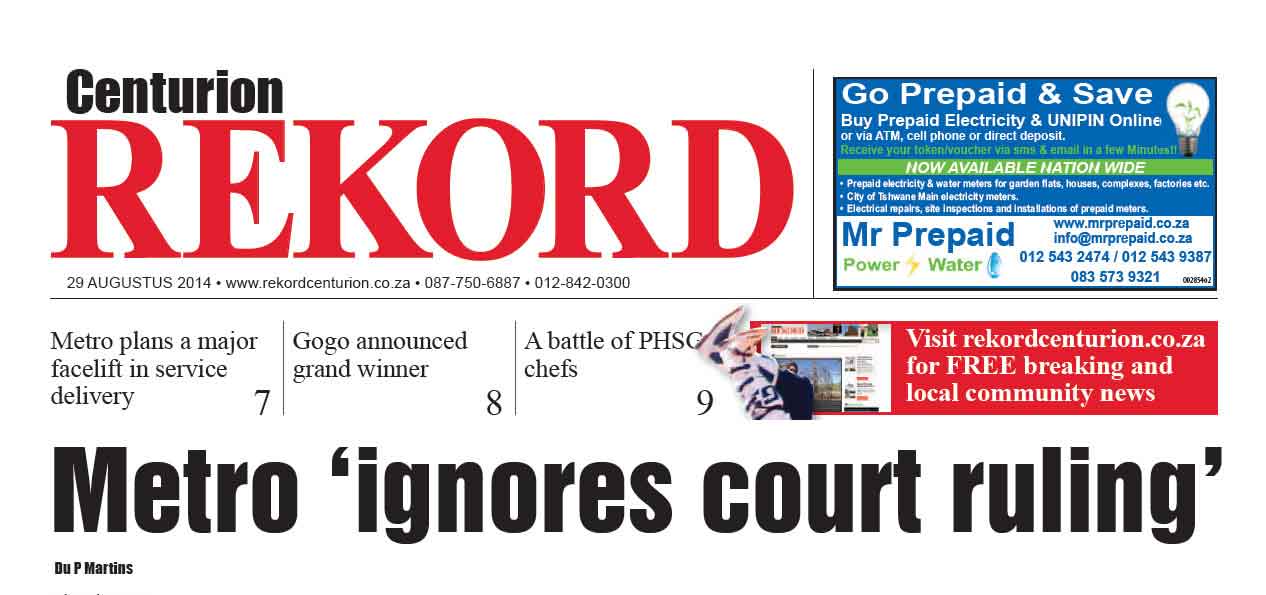
Centurion Rekord, 29 August 2014. The original front-page headline recorded the disagreement over municipal debts and the enforcement of an interim order concerning service provision.
Original reporting: Du P Martins · Publication: Centurion Rekord · Edition dated 29 August 2014.02 / Behind the headline
A buyer, inherited arrears and a dispute about services
The underlying proceedings concerned property buyers who had acquired immovable properties after previous owners left municipal accounts unpaid. One of the applicants, identified in subsequent court records as Ms Kekana, had acquired a property through a sale in execution. The historical municipal debt arose under a prior owner's account.
The litigation records describe the City of Tshwane's refusal to enter into a municipal-services agreement with the new owner unless the older debt was addressed. The dispute raised a critical question: what obligations, if any, could lawfully be placed upon a new purchaser who did not incur the prior owner's debt?
At that stage the legal arguments were actively contested. An interim order requiring services to be provided was not the same as a final determination of every question about section 118(3) of the Municipal Systems Act.
Property had transferred
The buyers were dealing with accounts arising before their ownership, not routine charges they themselves had incurred.
Services were in issue
Access to municipal service agreements became a practical pressure point in the dispute about historic debt.
Final law remained unsettled
The 2014 interim relief preceded the substantive 2016 High Court proceedings and the eventual 2017 Constitutional Court ruling.
03 / The chronology
From an urgent service dispute to constitutional clarity
The original newspaper report is one part of a longer legal record. The following dates are drawn from the contemporaneous publication and subsequent judgments.
Interim relief in the Jordaan proceedings
The High Court granted interim relief concerning municipal services to Ms Jordaan in the separate Tshwane proceedings, pending the determination of broader questions.
Interim relief in the New Ventures-linked proceedings
A similar order was granted against Tshwane for Kekana, Maleboloa and Mamotsau. The litigation involved New Ventures Consulting & Services (Pty) Ltd among the applicants.
Centurion Rekord reports the dispute
The newspaper described the continuing confrontation over access to municipal services and debts attributed to the previous owner. This was reporting on an unresolved situation.
The consolidated High Court decision
In proceedings including New Ventures, Jordaan and the Livanos matters, the Gauteng High Court held that the contemplated operation of section 118(3) against new owners raised a constitutional difficulty and granted substantive relief.
The Constitutional Court determines the issue
Our Jordaan litigation and the related New Ventures and Livanos appeals culminated in a unanimous judgment declaring that the section 118(3) charge does not survive transfer to make the new owner liable for historical debts incurred beforehand.
04 / The statutory distinction
Two subsections. Two different legal functions.
The dispute is easier to understand when the municipal clearance requirement is distinguished from the separate security mechanism under section 118(3).
The transfer-clearance mechanism
Section 118(1) restricts registration of transfer unless the prescribed municipal certificate has been produced. The certificate addresses amounts falling within the statutory two-year period preceding its application, subject to the legislation and applicable law.
The municipality's security for debt
Section 118(3) creates a statutory charge over property for recoverable municipal debt and gives it preference over registered mortgage bonds while the charge operates. Its function is legally distinct from the two-year clearance-certificate provision.
Crucially: the Constitutional Court did not invalidate section 118(3), and it did not erase municipal debts. It determined that the charge does not survive transfer in a way that makes a purchaser responsible for the preceding owner's debt. Municipalities retain lawful recovery remedies against the liable debtor, subject to the law.
05 / The people and proceedings
Who was involved, and why the distinctions matter
Historic reporting and court papers do not always use the same institutional names. The roles of litigants, business principals, advisers and instructed legal representatives should not be merged.
New Ventures
New Ventures Consulting & Services (Pty) Ltd was a named applicant in the Tshwane High Court proceedings, case 13039/2014, and appeared in the later consolidated Constitutional Court litigation.
Livanos and the wider challenge
The 2014 Rekord report referred to Peter Livanos in connection with the campaign over historical debts. Separate litigation involving Livanos interests and Ekurhuleni formed part of the consolidated 2016 and 2017 proceedings.
MDS and legal representation
Municipal Debt Specialist preserves and explains this history of the campaign. The litigating companies, individual applicants and their instructed attorneys each performed distinct roles; participation in public advocacy is not the same as appearing as an attorney of record.
Why this archive matters
The media attention arose from real difficulties confronting purchasers, including service access and uncertainty around pre-transfer charges. The legal journey belongs to the litigants and courts; the newspaper's independent reporting documents how those issues were understood by the public at the time.
06 / The final position
What the Constitutional Court ultimately decided
On 29 August 2017, the Constitutional Court decided the consolidated Jordaan, New Ventures and Livanos proceedings, reported as [2017] ZACC 31. The Court resolved the dispute through a constitutional interpretation of section 118(3), rather than striking the subsection down.
The central result was that the statutory charge under section 118(3) does not remain enforceable against a transferred property so as to impose a previous owner's municipal debt upon the new owner. The Court declined to confirm the earlier declaration of invalidity because this interpretation avoided the constitutional problem.
The municipality's historic claim does not turn the incoming owner into the debtor merely because ownership has changed.
This is an editorial explanation of the judgment's effect, not a quotation from the court. The existing debt may remain recoverable through lawful avenues against the party legally responsible for it.
What was different in 2014?
When Centurion Rekord reported the Tshwane dispute, property buyers and their legal representatives were navigating unresolved legal questions about the municipality's security, historic arrears and the provision of municipal services.
What is clear after 2017?
The Constitutional Court settled the pivotal section 118(3) transfer issue. That does not mean property transfers are free of municipal clearance requirements, that old debts disappear, or that every dispute over clearance figures has the same legal answer.
07 / Examine the record
Primary legal sources and related reading
The newspaper image establishes the date and appearance of the original public reporting. The judgments below provide the authoritative legal record for the subsequent proceedings and their outcome.
Press source: Centurion Rekord, 29 August 2014; journalist Du P Martins. The legal history is supported by the linked court judgments.
Historical perspective / Today's assistance
High City of Ekurhuleni clearance figures holding up a transfer?
MDS currently accepts enquiries about potentially qualifying City of Ekurhuleni property-transfer clearance figures. You can submit the issued figures for a free initial assessment, without an obligation to proceed.
Accepted matters are handled on agreed terms, normally on a contingency basis without upfront MDS professional fees. Not every matter qualifies, and no reduction or completion time is guaranteed. We do not handle ordinary monthly municipal billing enquiries.
Contact MDS
Send us the figures.
Include the municipality, amount claimed, property area and transfer status so we can establish whether the matter falls within our current scope.
What the report was examining
The difference between a transfer and an account
The central problem was not simply whether the municipality was owed money. It was whether an incoming property owner could be obstructed from obtaining municipal services because someone else had incurred debt before the transfer.
Why its timing matters
An unresolved dispute in 2014
The newspaper appeared before the later judgments that settled the central issue. Its language must be read in that historical setting, not treated as a description of today's law.