
For the record · National press · 16 February 2016
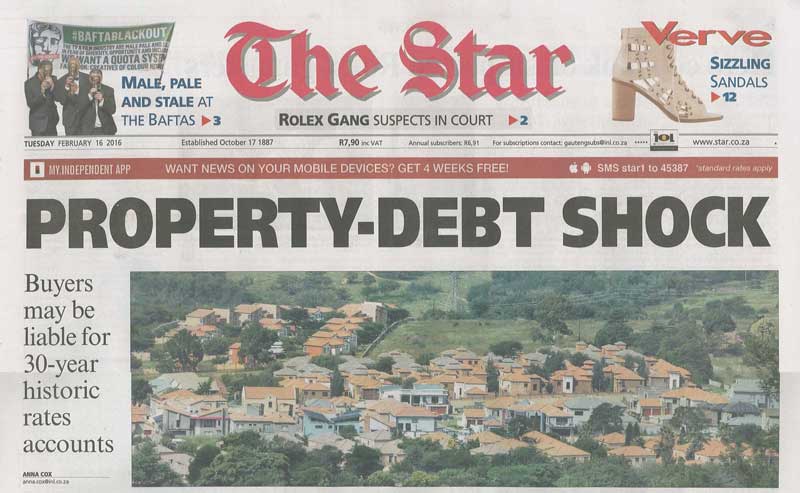
Property Debt Shock: when The Star reported a growing threat to new owners.
In February 2016, South African newspaper coverage brought renewed attention to the possibility that a property could be pursued for municipal debts incurred by someone who owned it years earlier.
The reporting featured the growing municipal-debt dispute and the consequences feared by new property owners. This account traces the public concern in 2016 and the legal clarification delivered in 2017.
01 / The Star · 16 February 2016
The day a newspaper headline captured a national property-law concern.
On Tuesday 16 February 2016, The Star carried Anna Cox's front-page report Property-Debt Shock. It examined the uncertainty created by a recent Supreme Court of Appeal decision concerning unpaid municipal debts associated with property that had already changed hands.
The report focused on a dilemma with practical consequences: a purchaser could complete a transfer through the required municipal-clearance process and still face attempts to recover historical municipal charges linked to a former owner. The concern was whether an older statutory charge could continue to burden the property after transfer—not that a former owner's personal debt automatically became the purchaser's personal debt.
The article described a Tshwane purchaser whose property had been transferred after a clearance process, only for a substantial historic amount to be raised later. That example illustrated why the issue mattered to conveyancers, estate agents, sellers, purchasers and financial institutions. It also highlighted concerns about municipal account accuracy, missing records and the difficulty of investigating very old transactions.
Livanos and the wider property industry were part of the public discussion.
The Star sought comment from people familiar with municipal clearance disputes, including Livanos. His comments conveyed concern about the potential repercussions for purchasers, sellers, attorneys and the wider industry. The response was not limited to the financial cost of old accounts: it raised questions about fairness after a purchaser had relied on the statutory transfer process.
Other legal practitioners quoted in the report discussed possible implications for transactions, the property market and the responsibilities of municipalities to scrutinise and recover debts before transfer. Their contemporary views reflect the debate in February 2016; they should not be read as statements of the law following the subsequent Constitutional Court judgment.
It put a technically complex Section 118 dispute into language the public could understand: what protection does a buyer have after registration, and how should lawfully recoverable historic municipal debts be treated?
02 / The legal question
Two mechanisms were at the centre of the dispute.
Section 118 of the Local Government: Municipal Systems Act 32 of 2000 operates in more than one way. Section 118(1) deals with the certificate required before transfer can be registered, while Section 118(3) creates a separate statutory charge over property securing municipal claims.
The disputed issue in 2016 concerned whether the latter charge could survive a lawful transfer and continue to burden an innocent buyer for debts incurred by a previous owner. The concern was therefore about the effect of the charge, not the wholesale cancellation of genuine municipal debt.
A dispute over clearance figures—and an unresolved balance
The published Supreme Court of Appeal judgment in City of Tshwane v Mitchell records a municipal statement of R232,828.25, a clearance payment of R126,608.50, and a remaining historical balance of R106,219.75. The dispute illustrated how obtaining a clearance certificate and dealing with an older, separately recoverable account were not necessarily the same thing.
These amounts are taken from the 29 January 2016 Supreme Court of Appeal judgment, not from a transcription of the newspaper article.
New Ventures Consulting & Services and Livanos-related property interests were involved in related litigation that subsequently reached the Constitutional Court alongside the Jordaan matters. The fact that Livanos was commenting in the press during this period provides useful contemporary context, but the newspaper report should not be mistaken for the formal court record.

Current property-transfer enquiries should be assessed using the issued municipal clearance figures and the actual transaction circumstances.
03 / The legal outcome
From a February 2016 warning to the Constitutional Court's final answer.
Supreme Court of Appeal
The Mitchell appeal heightened the concern about the statutory charge and debts incurred before a purchaser acquired the property.
High Court proceedings
Related property-owner cases, including New Ventures and Livanos matters, resulted in a High Court declaration concerning the operation of Section 118(3).
Constitutional Court
Our Jordaan litigation established that the Section 118(3) charge does not survive transfer to burden an innocent new owner with an earlier owner's debt.
Transfer does not make the new owner liable under the predecessor's Section 118(3) charge. Lawful municipal debt owed by the original debtor is not automatically extinguished.
Importantly, the Constitutional Court did not declare Section 118(3) invalid. It interpreted the provision consistently with the Constitution. The formal appeals succeeded because the declaration of invalidity was not confirmed, while the property-owner parties obtained the substantive interpretation they had pursued.
Read the final Constitutional Court judgmentOur Jordaan matter · [2017] ZACC 31 · 29 August 2017
Open the official court archive ↗04 / Related historical record
Follow the story through primary judgments and related reporting.
A historical story · A practical next step
High Ekurhuleni clearance figures delaying a property transfer?
MDS currently focuses on potentially qualifying City of Ekurhuleni municipal clearance matters. You can send your issued figures for a free initial expert assessment, without an obligation to proceed.
Accepted matters are handled on agreed contingency terms, normally without upfront MDS professional fees. Not every matter qualifies and no reduction or turnaround time is guaranteed.
Speak to our team
Where possible, include the amount claimed, the issued clearance figures and the status of the transfer.