
A DOCUMENTED LEGAL HISTORY / NEW VENTURES · MDS · LIVANOS
The New Ventures litigation behind South Africa’s landmark Section 118 judgment.
Before the Constitutional Court ruled in 2017, Livanos and New Ventures Consulting & Services had spent years confronting historical municipal debt through property transactions, clients’ cases and sustained litigation. The story of Jordaan begins long before the hearing that made national legal history.
The High Court records New Ventures as an applicant in multiple proceedings; the Constitutional Court itself names it in the titles of the consolidated matters. Behind those names was a specialist business created out of Livanos’s first-hand experience as a property investor.

01 / THE ORIGINS OF NEW VENTURES
It began in property investment. It grew into a national legal battle.
Livanos’s experience purchasing, redeveloping and transferring property — particularly properties acquired at sheriffs’ sales in execution — exposed a recurring problem: municipal clearance demands that could radically alter the economics of a transaction.
Through the family’s property investment and redevelopment activities, including New Ventures Properties, Livanos encountered clearance amounts that did not necessarily correspond with the figures on which a purchaser had originally relied. Investigating those demands became specialist work in its own right. New Ventures Consulting & Services developed from that practical experience, and Municipal Debt Specialist carries that expertise forward today.
The cases were not built around an abstract legal question. They arose from real property owners, real transfers, applications for municipal services and substantial demands relating to debts incurred before those owners took transfer. Some were clients of New Ventures; other interests were directly connected with Livanos’s property businesses.
Gemma Diamonds (Pty) Ltd was a Livanos-owned property-holding company. It acquired a property from a company in liquidation and later challenged Ekurhuleni’s treatment of the former owner’s historical debts. The same body of High Court proceedings includes Billie Ann Livanos, other affected owners and New Ventures. These are separate applicants, linked through the wider litigation history.
Livanos directed the enterprise behind the litigation: developing the specialist operation, working with affected clients, coordinating mandates and retaining and funding legal representation over many years. The attorneys and advocates conducted the professional legal proceedings; the entrepreneurial commitment and long-term undertaking came from Livanos and New Ventures.
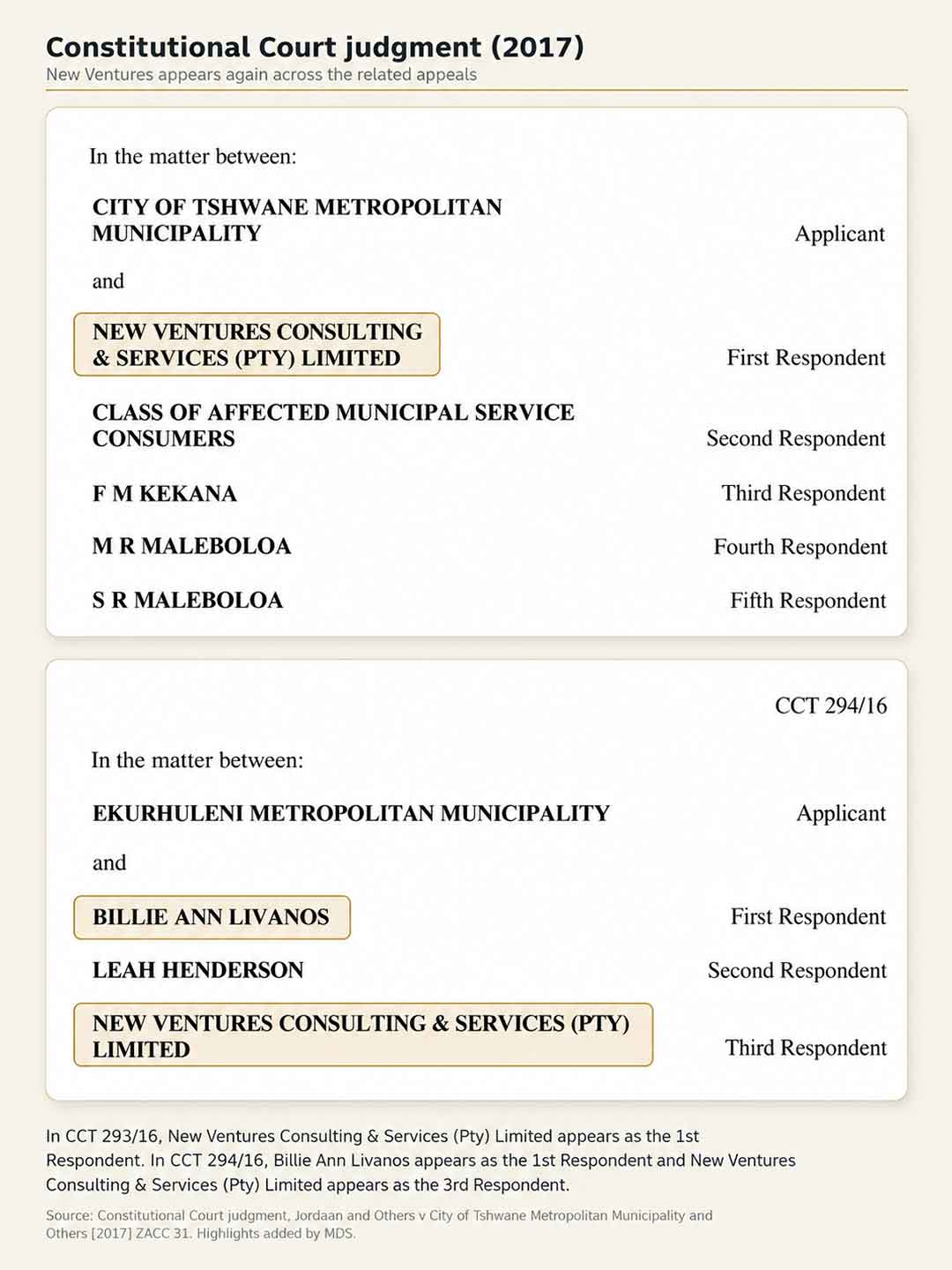
Five matters heard together; New Ventures appears in each applicant listing, although the final fifth substantive claim was not pursued.
CCT 283/16, 293/16 and 294/16, with New Ventures expressly named across the party lists.
29 August 2017: the Court declared that the section 118(3) charge does not survive transfer against a new owner.
The five applications recorded by the Pretoria High Court
The original High Court judgment of 7 November 2016 records the parties and describes the transactions. Read the judgment ↗ Explore the property-investment origins ↗
THE COURT RECORD / ORIGINAL APPLICANTS
New Ventures is written into the record — from the High Court to the Constitutional Court.
The party listings tell the story in the courts’ own case numbers. New Ventures was an original litigant, repeatedly named alongside the property owners and other applicants, not a late participant in proceedings initiated by another institution.
These four annotated MDS case-record illustrations present the relevant party listings for readability. For the full court documents and judicial reasons, open the original judgments linked beneath each image.



02 / STRATEGY AND PERSISTENCE
A sustained campaign, built from transactions, evidence and legal action.
The work of New Ventures brought individual property disputes into focus as a larger problem for ownership, conveyancing and mortgage security throughout South Africa.
The property experience
Sheriffs’ sales, redevelopment and property transfers exposed the effect of unexpected municipal clearance demands.
The specialist investigation
New Ventures developed the ability to interrogate account histories and distinguish demands from lawfully recoverable amounts.
The court proceedings
Affected owners and New Ventures brought multiple matters against Tshwane and Ekurhuleni, instructing attorneys and counsel.
The nationwide implications
The danger to buyers, banks and conveyancers became unmistakable — and brought sector institutions into the final proceedings.
03 / THE FACTUAL FOUNDATION
Behind the legal question were years of real property transactions.
The experience behind New Ventures and MDS was grounded in years of handling high municipal clearance figures and troubled property transfers. The work required scrutiny of billing histories, duplicated or potentially incorrect charges, the age of debts, and the relationship between figures required for clearance and the wider account.
For Livanos and New Ventures, the financial analysis came first. Historical billing records and complex clearance figures revealed the practical consequences of municipalities treating new owners as a means of recovering old liabilities. A legal dispute grew from those experiences — not merely from a theoretical disagreement about a statute.
As the investigations developed, their commercial significance became impossible to ignore: old municipal charges could threaten an entirely new owner, even where that purchaser had no connection with the previous consumption or account. The question reached far beyond a single municipal statement.

04 / THE LEGAL DESIGN
Three questions that brought the contradiction into view.
The core problem was not whether municipalities should collect money lawfully owed to them. The question was whether their security over a property could continue to burden a different owner after transfer.
Who actually incurred it?
A purchaser who had no connection with the former owner's municipal consumption was being confronted with the earlier account.
How could a buyer know?
The statutory charge was not necessarily registered against the property's title in a way that warned a purchaser of historic debt.
Could it follow the title?
If the charge endured against a new owner, that interpretation raised serious concerns about arbitrary deprivation of property.
The Court approached Section 118(3) through statutory history, common-law principles and constitutional interpretation. It concluded that the charge does not survive transfer, avoiding an interpretation that would unjustifiably burden innocent new owners. See Jordaan and Others [2017] ZACC 31, especially paragraphs 25–29 and 54–81.
What was not in dispute
Municipalities retain important lawful recovery powers against the existing owner, including a statutory charge for recoverable debts and preference over mortgage bonds before transfer.
What could not be carried forward
The former owner's Section 118(3) charge could not continue against an innocent new owner simply because ownership had changed. The underlying personal debt was not thereby automatically cancelled.
05 / WHY THE STAKES WERE NATIONAL
Why financiers, banks and conveyancers had a stake in the outcome.
If an undisclosed historical municipal debt could follow property after registration, a buyer might acquire far more than the title deed revealed. In extreme cases, the purchaser’s home or investment could be exposed to execution for somebody else’s debt. That possibility would undermine the predictability of buying, financing and transferring immovable property.
For banks and mortgage lenders, the danger was to the security for loans granted after transfer: the financier could value and finance a property without knowing that a historical municipal charge might be asserted against it. For TUHF and other property financiers, uncertainty could affect investment and lending, particularly in housing transactions. For conveyancers, the municipalities’ interpretation could create difficult questions about disclosure, searches and professional responsibility where historic arrears were not readily ascertainable.
These were not remote consequences. The Constitutional Court itself described the potential for a new owner’s property to be sold in execution, and for a mortgage lender’s security to be undermined. The sector institutions had substantial legal and commercial interests in the interpretation before the Court.
Livanos’s strategic objective, as described in MDS’s history, was to expose the wider consequences of the municipal position. By the Constitutional Court stage, the risk was unmistakably national. The supporting amici added their own legal arguments to a dispute already brought forward by the original litigants.
06 / THE INSTITUTIONS WHO ENTERED AT THE FINAL STAGE
Friends of the Court — not the parties who launched the case.
An amicus curiae assists the Court by offering a perspective on an issue in proceedings that already exist. It does not become the original litigant, and its attorneys do not thereby become the attorneys who brought the original applications.
TUHF Limited
The social-housing financier questioned the nature and enforceability of a municipal security right against a new owner. It supported a reading of Section 118(3) that avoided transferring historic debt burdens to purchasers.
Why it mattered: financing housing on property vulnerable to undisclosed pre-transfer debts would expose both projects and creditors to uncertainty.
Banking Association South Africa (BASA)
Representing banking-sector interests, BASA argued that extending such a charge against a new owner would threaten the rights of subsequent mortgagees, not only the owners themselves.
Why it mattered: the value and reliability of mortgage security are fundamental to property lending.
eThekwini Metropolitan Municipality
Unlike the first two amici, eThekwini supported Tshwane and Ekurhuleni. It advocated a municipality-friendly interpretation of the statute, emphasising revenue collection, civic responsibilities and municipal service delivery.
Why it mattered: the judgment could affect the debt-collection position of municipalities beyond the two originally sued.
Johannesburg Attorneys Association (JAA)
The JAA addressed whether conveyancers could be expected to disclose sellers’ historic municipal debts. It applied after the oral hearing, was admitted on 5 June 2017 and filed written submissions on 9 June.
Why it mattered: the interpretation advanced by eThekwini raised difficult questions about conveyancers’ professional obligations. The Court ultimately did not need to decide the JAA’s submissions.
Constitutional Court judgment paragraphs 3 and 13–14 and footnote 29 sets out the positions and the JAA’s exact post-hearing chronology.
07 / WHO REPRESENTED EACH PARTY
The advocates and instructing firms recorded by the Constitutional Court.
The Court’s appearances page lists each set of advocates with its instructing law firm. The original applicants’ attorneys and advocates represented clients whose cases had been pursued through the High Court years earlier. The judgment separately records counsel for the municipalities, the Minister and three amici, while the fourth amicus filed written submissions after the hearing.
Jordaan, New Ventures and the other original applicants
The property owners and New Ventures who brought the underlying proceedings and resisted the municipal appeals.
D Unterhalter SC · L G F Putter SC · H Varney · S Ogunronbi
City of Tshwane Metropolitan Municipality
Appealed the High Court ruling and argued for its interpretation of the municipal security.
T Motau SC · A Vorster · S Scott · I Phalane
Ekurhuleni Metropolitan Municipality
Appealed the High Court judgment in CCT 294/16.
W J Vermeulen SC · P Sieberhagen
Minister of Cooperative Governance and Traditional Affairs
Supported the municipalities’ construction of section 118(3).
L Montsho-Moloisane SC · L Bomela · K Bokaba
TUHF Limited
Supported the applicants’ interpretation from the perspective of property finance.
I Miltz SC · J J Bitter
Banking Association South Africa (BASA)
Addressed the risk to mortgage security and subsequent bondholders.
A Cockrell SC · C Tabata
eThekwini Metropolitan Municipality
Aligned itself with Tshwane and Ekurhuleni on the municipal-collection interpretation.
A A Gabriel SC · J P Broster
Johannesburg Attorneys Association
Admitted on 5 June 2017; written submissions filed on 9 June 2017 about conveyancers’ duties.
The judgment records the Association’s participation but does not list a separate firm-and-counsel team for it on the appearances page.
Ross Attorneys, including Gary Ross, acted as instructing attorneys for the original applicants on the mandate coordinated by Livanos and New Ventures. Their work with the advocates formed the applicants’ professional legal representation. In TUHF’s separate application to join as a friend of the Court, Schindlers partner Chantelle Gladwin-Wood deposed to an affidavit on TUHF’s behalf. These professional mandates formed part of the proceedings that the original applicants had already pursued for years.
Legal-team attributions: Constitutional Court judgment, final appearances page (page 37) ↗. The Association’s admission and filing dates are recorded in footnote 29. TUHF’s application affidavit ↗ identifies Chantelle Gladwin-Wood’s role.
08 / THE PEOPLE BEHIND THE CASE
Livanos led the undertaking that carried the cases to the Constitutional Court.
The original litigation reflected real experiences: Chantelle Jordaan, the Kekana and Maleboloa applicants, Billie Ann Livanos, Leah Henderson, Gemma Diamonds and other owners faced the practical consequences of historical municipal debt claims. Their names appear in the reported proceedings because their rights and transactions were at stake.
Livanos planned, directed, coordinated and financed the long-running campaign through New Ventures and its associated property interests. The business retained the attorneys who formally represented its clients and the other applicants. Litigation through multiple matters and successive years required more than a single appearance in court: it required the sustained commitment behind the mandates, documents, professional fees and risk.
The history was reported independently at the time. On 30 August 2017, Cape Times journalist Anna Cox identified Livanos among those who took the case to the Constitutional Court and reported his statement that he had spent approximately R11 million in legal costs since 2000. Read the contemporary report ↗
The names in the court papers belong to the owners and businesses who were actually litigating. Livanos and New Ventures provided the enduring strategic and commercial drive behind the wider campaign.
09 / WHEN THE PUBLIC HEARD THE STORY
Carte Blanche brought #NotMyDebt into homes across South Africa.
On Sunday, 24 August 2014, M-Net’s Carte Blanche featured the national investigation “Not My Debt”, examining how new owners were confronted with unpaid municipal charges left by predecessors. An independent programme listing published two days earlier records the subject and broadcast schedule.
For MDS, this was an important national moment during the years in which these disputes were already being fought. Viewers could see the human consequences of the legal question: how could an owner who had not incurred an old debt be exposed to a municipal demand for it?
MDS’s contemporary archive records that #NotMyDebt became South Africa’s number-one Twitter trend following the Carte Blanche feature. The existing historic image preserves that claim. The television exposure — rather than the 2017 judgment, still three years away — explains the public response preserved in the historic screenshot.
10 / THE PUBLIC CHRONOLOGY
The chronology makes the legal roles unmistakable.
Property investment, redevelopment and purchases at sheriffs’ sales expose Livanos to the problems created by unexpectedly high municipal clearance demands. Specialist New Ventures consulting work grows from that experience.
Five High Court proceedings commence under case numbers 74195/2013, 13039/2014, 13040/2014, 23826/2014 and 19552/2015, involving New Ventures and affected property owners.
Interim High Court orders address municipal services while the principal dispute continues. These early proceedings pre-date any amicus involvement at the Constitutional Court.
Carte Blanche broadcasts “Not My Debt”, bringing the dispute to a national audience and prompting the #NotMyDebt social-media response described in MDS’s archive.
Justice D S Fourie delivers judgment in the Pretoria High Court proceedings. The Court grants important declaratory relief and declares the provision invalid to the limited extent described in its order, subject to constitutional confirmation.
The Constitutional Court hears the combined cases. TUHF, BASA and eThekwini participate as amici; their counsel are listed separately from the original applicants’ counsel.
Following the hearing, the Johannesburg Attorneys Association is admitted as the fourth amicus on 5 June and files written submissions on 9 June.
Justice Edwin Cameron delivers the unanimous judgment. Section 118(3) is upheld on an interpretation that its charge does not survive transfer to burden a new owner for a predecessor’s debt.
11 / WHAT THE CONSTITUTIONAL COURT ACTUALLY ORDERED
The applicants prevailed on substance. The Court preserved section 118(3) with a decisive interpretation.
The Pretoria High Court had made a limited order of constitutional invalidity. The Constitutional Court chose a different route: it held that Section 118(3) could and must be interpreted constitutionally, so no declaration of invalidity was necessary. On that technical basis, the municipalities’ appeals succeeded.
The substance of the applicants’ case nevertheless prevailed. The Court held that the statutory charge does not survive transfer, and ordered that the appellants and the Minister pay the applicants’ costs, including the costs of two counsel. The Court expressly drew the distinction between the appeals’ form and the victory on substance (paragraphs 78–81).
The decision protects new owners against enforcement of an earlier owner’s municipal debt through that charge. It does not erase the original debtor’s obligation or the municipality’s available lawful enforcement remedies before transfer.
THE CASE AT A GLANCE
Who brought the case, and what did the Constitutional Court decide?
Which litigants brought the High Court applications?
Chantelle Jordaan, New Ventures Consulting & Services, Billie Ann Livanos, Gemma Diamonds and other affected applicants were named in the underlying High Court matters. New Ventures appears as an applicant across all five case listings.
What was Livanos’s role?
Through the property business and New Ventures, Livanos developed the specialist work and directed and financed the long-running litigation undertaking. His financial involvement was independently reported immediately after the 2017 judgment.
Which legal firm instructed counsel for the original applicants?
Ross Attorneys instructed the four advocates listed for the original applicants on the Constitutional Court’s appearances page. Other firms represented municipalities, the Minister and the amici curiae.
What did Jordaan [2017] ZACC 31 decide?
The Court declared that a charge under section 118(3) for debts predating transfer does not pass to the new owner. It did not confirm the High Court’s declaration of constitutional invalidity; the applicants nevertheless prevailed on the substantive point.
12 / THE PRIMARY COURT AND MEDIA SOURCES
Read the judgments, legal-team record and contemporary reporting.
The litigation’s parties, case numbers, final outcome and counsel teams can be checked directly against the judgments. The separate 2014 programme listing and MDS archive document how the public first encountered the story on television.
Why these records matter
They provide more than a description of a judgment. They illustrate years of practical work, the cases taken forward, and the moment South African property law gained greater clarity about historical municipal debt.
For the historical index of national television, radio and press coverage, including attributed publication references and the official SABC News YouTube link, visit our dedicated media archive.
13 / THE PRACTICAL RELEVANCE TODAY
The judgment was a milestone. Every transfer still needs its own assessment.
Even after our Constitutional Court victory, a property transfer can still be disrupted by high clearance figures, inaccurate billing, unresolved historic charges or confusion between certificate figures and an account's full lawful liability.
That is the practical connection between the litigation and MDS's work today: careful legal and account investigation before payments, settlements or administrative shortcuts narrow the options.
MDS today focuses primarily on qualifying Ekurhuleni municipal clearance matters arising from property transfers. We offer an initial assessment free of charge and without obligation, and work alongside transferring attorneys where a matter is accepted. Every account and legal position requires its own review.


Our work considers Section 118(1), Section 118(3), billing errors, apportionments, recoverability, prescription and many other legal, financial and administrative variables developed through extensive experience. It is not an automatic debt reduction or a substitute for professional conveyancing advice.
14 / FURTHER READING
Explore the original matters, legal history and media coverage.
Explore the people, court proceedings, legal history and contemporary coverage that shaped this milestone.