
First he interrogated the figures. Then he challenged the legal power behind them.
The breakthrough began with an uncommon discipline: dismantling complex municipal accounts line by line, testing each charge against the law and establishing what could properly be demanded. Livanos then recognised a more far-reaching problem—municipalities were invoking historical debts against people who had acquired property from someone else. That insight became the foundation of a directed legal campaign with national consequences.
The story of specialist financial-legal analysis, Livanos’s strategic direction through New Ventures, the counsel he instructed and the litigation that reached South Africa’s Constitutional Court.

A clever legal strategy does not begin by announcing victory. It begins by asking a better question than the one the other side wants to answer.
Municipalities could point to unpaid historical balances on a property. But the new owners in these matters had acquired and registered their properties after those debts arose. The dispute was not simply whether money remained owing; it was whose liability it was, what security the municipality held, and whether that security could follow the property into the hands of someone who had never incurred the debt.
That distinction transformed the stakes. One overdue account could affect one transaction. A common interpretation of Section 118(3) could affect purchasers, conveyancers, mortgage lenders and municipalities across South Africa.
Look beyond the account. Find the legal assumption underneath it.
To understand the intelligence behind our Jordaan litigation, begin where Livanos began: with the figures themselves. A municipality could present an apparently authoritative account, yet the amount shown did not by itself answer the questions that mattered—when did each charge arise, who incurred it, what legal provision governed it, and what could lawfully be demanded for transfer or recovered against a particular owner?
Years of detailed account scrutiny and dealings with actual property transfers provided Livanos with a close understanding of those distinctions. When municipalities treated historical municipal debts as a continuing charge against property after a change of ownership, the issue became more than calculating an amount. It concerned the very source and limits of a municipality’s legal authority. A new purchaser who had completed transfer could face service refusals linked to debt incurred by someone else.
The crucial proposition was not that municipal debts should disappear. The municipality was entitled—and obliged—to pursue debts lawfully due to it. The strategic question was whether it could use its legitimate collection powers to shift the burden of a predecessor’s debt onto an innocent new owner.
Establish the timing, ownership history, account entries and transactions affecting each property.
Separate transfer clearance from the statutory charge and the municipality's lawful collection powers.
Test the claimed effect against property law, constitutional protections and the meaning of registration.
The figures were never simply accepted. They were interrogated.
Municipal Debt Specialist's defining expertise is the legal and forensic examination of municipal accounts: reconstructing what was charged, establishing who was liable, determining when the liability arose and calculating what the law actually permits a municipality to demand. This is the analytical foundation on which Livanos built his reputation—and a vital source of the insight he brought to the litigation.
Account interrogation · Statutory analysis · Legally supportable figures
Build the account from the source entries.
Examine transaction histories, service charges, rates, payment allocations, adjustments and credits. Establish the relevant dates and property-ownership history. An outstanding balance is not yet a legal conclusion.
Know precisely what each subsection does.
Section 118(1) governs the prescribed clearance certificate for the qualifying two-year period; Section 118(2) addresses transfers by trustees of insolvent estates; Section 118(3) creates a statutory charge and preference. They are connected provisions, not three interchangeable charges.
Determine the amount that can lawfully be demanded.
Test the legal basis of disputed components, distinguish clearance requirements from debts recoverable by other lawful means, and produce a defensible analysis for the conveyancer or municipality. The objective is correctness—not an automatic discount or debt write-off.
Turn detailed analysis into powerful instructions.
Where recurring cases reveal a common legal problem, properly investigated accounts and affected owners' experiences provide the foundation for informed legal instructions and carefully framed relief.
This is what distinguishes specialist municipal-debt consulting from simply checking an invoice or assuming that everything outside a two-year period has vanished. The expertise is in understanding the account and the law together—and being able to demonstrate the correct position. Why Section 118 is not a discount or write-off ↗
Five different property stories. One recurring fault line in the law.
The strength of the broader litigation lay in the fact that the issue did not arise in a single unusual transaction. Different owners, different properties and different dealings with Tshwane or Ekurhuleni exposed a common question: could municipal claims for a predecessor's debts be pursued against new owners by relying on a charge over the property?
Livanos had an unusual vantage point. Through New Ventures he knew the accounts, the history of the property transfers and the affected owners. According to MDS’s account of the litigation, he recognised the strategic potential of addressing the recurring legal principle across distinct matters, instructed the legal team on the direction of the challenge and sustained the campaign. The High Court heard five applications together, although they were not formally consolidated there. Each retained its own parties and facts; together they exposed the same question of statutory power.
The strength was in the pattern.
Separate owners and case records. A common statutory proposition. A court asked to resolve its consequences.
Does the Section 118(3) charge survive transfer?
Does an earlier owner's municipal debt remain enforceable against the property after a new purchaser becomes its owner?
The file numbers and compact party descriptions follow the MDS historical index; the official judgments remain authoritative for full party designations. These were related matters, not five identical cases.
Distinct factual situations considered together.
CCT 283/16, CCT 293/16 and CCT 294/16.
Whether the charge could continue against a new owner.
The strategy began with the ability to calculate what was lawfully due.
The power of the approach lay in joining two disciplines: specialist account interrogation and the strategic direction of litigation. Livanos was not observing the problem from a distance. Through New Ventures he was involved with the affected transactions and owners, knew the disputed municipal accounts and understood how the municipalities’ practices operated in the real world. The Constitutional Court later recorded that services were disconnected or consumer agreements refused to purchasers already registered as owners.
According to MDS’s historical account, Livanos set the strategic direction, instructed the legal practitioners on the objectives and approach to the cases, brought the specialist municipal-account expertise to bear and organised the resources needed to carry the challenge through successive courts. The instructed attorneys and advocates performed their professional legal roles, drawing on the facts, instructions and legal issues presented. These were complementary strengths in the same litigation effort.
Calculate the legal position from the ground up.
Trace the municipal entries, match charges to periods and owners, test credits and allocations, and identify the legal basis of each disputed demand.
Protect owners facing real service consequences.
Translate account evidence and the practical effects of service refusals into clear legal instructions for the remedies required in each affected matter.
Identify the recurring weakness in the law’s application.
Look past different accounts and property owners to recognise the same municipal proposition being relied on repeatedly—and instruct the legal team accordingly.
Sustain the instruction through every stage.
MDS’s history and the pre-hearing interviews describe Livanos and New Ventures directing, coordinating and funding a protracted challenge so affected owners did not have to fund it themselves.
An expert audit can expose an error. A strategic instruction can expose the rule behind it.
Accurate calculation of the legally supportable charges gave Livanos technical authority when confronting municipal demands. Seeing the same post-transfer historical-debt approach in several cases revealed something more consequential: a legal interpretation that needed to be tested at its source.
That is the heart of the strategy: use deep knowledge of the figures and the affected transactions to direct a coherent challenge to a recurring exercise of municipal power.
Explore how the original property disputes began ↗The decisive move was to test the source of authority.
The municipalities raised several overlapping justifications: statutory security for historical debts, their by-laws and collection policies, and their responsibility to finance essential public services. Those arguments could not be dismissed lightly. A municipality must collect what is lawfully due.
But in the Constitutional Court, the controversy returned to the central interpretation. The Court examined the statutory history, the common-law requirements for rights in land, the Constitution and the municipalities' existing collection remedies. It concluded that the charge in Section 118(3) did not continue after transfer so as to burden a new owner.
One of the Court's most telling observations concerned timing: municipalities already had substantial enforcement powers before transfer, when the clearance process gave them notice of an impending change of ownership. They could pursue lawful debts from the existing owner and, where justified, seek to stop transfer. The Court asked why those remedies should be converted into a new burden on an unrelated buyer after registration. That legal reasoning exposed the weakness in treating the property as an endlessly transferable source of security for historical debts.
Municipalities have statutory security and preference, receive notice of pending transfer through the clearance process and may seek appropriate relief against the existing owner.
The charge does not survive transfer against the new owner. Lawful claims against the original debtor remain a separate matter.
The litigation brought that fundamental distinction before the courts. Livanos’s role, as described in the MDS history, was to originate and direct the strategic challenge, instruct the lawyers acting for the affected parties and provide the specialist understanding of the municipal accounts and practices that gave the dispute its practical force. The instructed attorneys and advocates developed and presented the legal case within their professional responsibilities; the Constitutional Court determined the law.
Livanos & New Ventures
Strategic direction and instructions to the legal team; detailed expertise in municipal account analysis, Section 118 and affected property transactions; coordination and funding of the sustained campaign, as described in MDS’s account.
Instructed attorneys & counsel
The attorneys and advocates acting for the litigants prepared and prosecuted the proceedings, exercised their professional judgment and presented the legal submissions in court.
The Constitutional Court
Independent and binding interpretation of the statutory charge under Section 118(3), resolving the question of the charge’s effect after transfer.

A commercial conflict reached the highest judicial forum.
The published judgment identifies the connected matters as Jordaan and Others v City of Tshwane, City of Tshwane v New Ventures Consulting and Services, and Ekurhuleni v Livanos and Others.
The names matter because they show the presence of the affected property owners, New Ventures and Livanos in the litigation record itself—not merely in later commentary.
There was no abstract “test case” without the people living through it.
One of the most significant features of the history is that the clients were not invented for litigation. MDS's original account says New Ventures had already assisted the owners in earlier municipal-clearance matters and that their subsequent disputes concerning historical balances prompted further action.
That background matters because a successful legal challenge is not built on a slogan alone. It requires a person with a legal interest, facts that can be proved, a properly framed remedy and the resources to see the process through. In these proceedings, affected owners and companies brought those real circumstances into view.
Our Jordaan litigation involved several owners and related businesses, including the interests of Livanos and New Ventures. Their exact procedural roles were distinct, and the official court record—not a promotional description—determines their formal standing.
That is why the campaign involved both direct assistance and broader litigation. It was not merely a theory about Section 118; it concerned whether real people could receive services after acquiring properties without being required to settle debts incurred by someone else.
A legal strategy measured in years, not headlines.
The final judgment can make years of difficult groundwork seem inevitable. They were not. The cases moved through contested facts, municipal resistance, court applications, an order of constitutional invalidity in the High Court and an appeal and confirmation process before the Constitutional Court.
Early applications and service disputes, including the proceedings associated with Jordaan.
Further property owners and related New Ventures matters reached the High Court.
The Pretoria High Court determined the constitutional challenge and granted related relief.
The connected disputes were heard by the Constitutional Court.
Justice Cameron delivered the unanimous Constitutional Court judgment.
By June 2018, when this article was published, the case had become more than a dispute about historical balances: it was a completed example of sustained legal action turning a recurring property problem into an authoritative clarification of South African law.
The people who stood with the case when the argument reached the highest court.
The strategic work, the account analysis and the affected property owners’ experience all converged on a day when the legal arguments had to be made before eleven Constitutional Court judges.
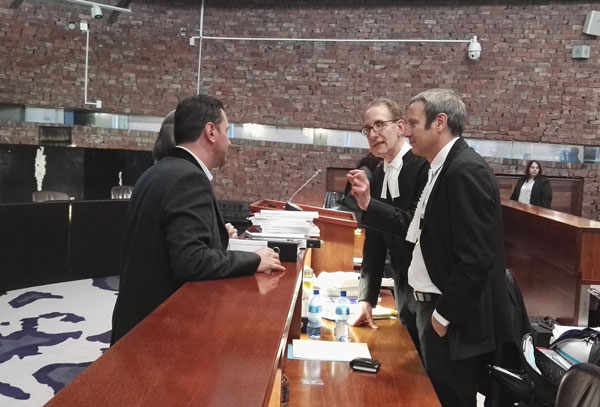
David Unterhalter SC and Howard Varney
This genuine courtroom photograph records a meaningful moment in our Jordaan litigation: Livanos alongside two advocates whose skill and legal work helped bring the property owners’ case before the Constitutional Court.
MDS records its sincere appreciation for their exceptional professional commitment, preparation and advocacy during a case of national importance.
Livanos’s strategic direction and specialist understanding of municipal accounts were brought together with the expertise of the instructed legal practitioners. The Court heard legal submissions advanced on behalf of the affected property owners; its judgment was delivered on 29 August 2017.
The judgment also records Linda Putter SC and S Ogunronbi among counsel for the property-owner parties, instructed by Ross Attorneys. View the official list of appearances in the judgment ↗
The deeper result: the Court did not need to strike the statute down to protect new owners.
At the High Court, the interpretation the municipalities advanced had led to a declaration of constitutional invalidity. The Constitutional Court reached the protective result through a different route: interpretation. Section 118(3) could remain constitutionally valid, because the charge it created did not survive ownership transfer to burden the buyer with the previous owner's debts.
This is a legally important distinction. The relief sought by the affected property owners was substantively vindicated even though the municipalities' appeals formally succeeded and the order of invalidity was not confirmed.
In form, the municipalities' appeals succeeded. In substance, the new owners' position prevailed.
The Court declared that the charge created by Section 118(3) does not make a new owner liable for debt arising before transfer. The applicants were awarded costs, including those of two counsel.
The municipality retains statutory collection powers, including mechanisms available while the existing owner still holds title. Lawfully recoverable debt does not vanish simply because a certificate is issued.
The Section 118(3) charge does not travel with the property after transfer and impose a predecessor's debt on the new owner. The original debtor's lawful obligations remain a separate issue.
The ruling was not a blanket write-off of municipal debt and did not remove the need for a lawful rates-clearance process. It removed the interpretation under which a new purchaser could be burdened by a former owner's historical debts by virtue of the Section 118(3) charge after transfer.
For Livanos and New Ventures, the significance was larger than the resolution of any one file. Their long-running challenge, alongside the work of instructed legal practitioners and the other litigants, formed part of the litigation that resulted in a rule with national significance.
The outcome was not about overpowering a municipality. It was about establishing the limit of its power.
The strategic achievement is best understood as a change in scale. First, individual account and service disputes were documented. Then a recurring legal theory was identified across different owners and files. That theory was examined through a sequence of High Court matters and, ultimately, by the Constitutional Court.
What makes this history compelling is the combination of analytical precision and strategic ambition. Livanos brought specialist account knowledge into a campaign concerning real property owners, gave direction to the legal teams he instructed and pursued a question with implications far beyond any single transaction. The resulting judicial interpretation protected subsequent purchasers from the disputed post-transfer effect of the Section 118(3) charge.
That discipline still defines Municipal Debt Specialist: the meticulous interrogation of figures, the calculation of what may lawfully be required for transfer, the distinction between a debt and the person legally responsible for it, and the capacity to put a well-founded analysis before the relevant professionals and municipality. There is no automatic write-off and no shortcut. The skill is to establish the correct position through evidence, calculation and law.
The documents behind the story.
Case record and associated judgment materials for CCT 283/16, 293/16 and 294/16.
The statutory framework for Section 118, including the clearance requirement, insolvent-estate provision and municipal charge.
The Court's reasoning, formal order, parties and appearances.
Livanos described the affected owners, the practical problems and New Ventures' role before judgment was delivered.
Contemporary reporting and MDS's collection of the public history surrounding the litigation.
High Ekurhuleni clearance figures threatening your transfer?
Send MDS the actual City of Ekurhuleni municipal clearance figures for a free initial expert assessment. We examine the account, the property-transfer circumstances and the legal basis for the amounts demanded to determine whether further assistance is appropriate.
Or email rateshelp@livanosgroup.co.za.