
How the Jordaan Case Changed Property Law in South Africa
The Problem Began Long Before our Landmark Constitutional Court Victory
The Constitutional Court judgment in the Jordaan matter in August 2017 is widely recognised as a turning point in South African property law. However, the issues that ultimately led to this decision did not originate in 2017 — or even in 2013 when the litigation formally began.
It began much earlier.
Want to know about the origins of Municipal Debt Specialist, view our article:
When a Property Investor Was Forced to Challenge High Clearance Figures — and Changed the Law

Why These Cases Mattered Beyond the Individual Matters
While the litigation arose from individual matters (Chantelle Jordaan, Maria Kekana, Gemma Diamonds, Livanos or any of our individual applicants), the legal principles under consideration extended far beyond the parties involved.
The legal principles under consideration had implications for:
- Every property owner.
- Every purchaser.
- Every conveyancer.
- Every bank.
- Every estate agent.
- Every municipality.
The outcome would determine how historical municipal debt would be treated throughout South Africa and whether innocent purchasers could be exposed to liabilities incurred by previous owners.
For this reason, the litigation attracted national attention and ultimately became one of the most significant property law matters to reach the Constitutional Court.

Constitutional Court to Hear New Ventures Consulting & Services / Municipal Debt Specialist
The Origins of the Dispute
Shortly after the introduction of Section 118 of the Local Government: Municipal Systems Act in the early 2000s, disputes began to emerge around the interpretation and application of municipal debt in the context of property transfers.
From as early as 2002, New Ventures Consulting & Services – Livanos (now Municipal Debt Specialist) began engaging with municipalities through litigation and structured dispute processes to address inconsistencies in how municipal debts were calculated and recovered.
At the time, the core objective was simple:
To ensure that property owners paid what was legally due — and no more.
What started as a technical and legal issue would, over time, evolve into a national legal question affecting property owners across South Africa.

Building a Specialised Municipal Debt Practice (2002–2013)
Over the following decade, New Ventures Consulting & Services developed a highly specialised practice focused on municipal debt, clearance figures, and Section 118 compliance.
Developing Practical Methodologies
Through ongoing interaction with municipalities and involvement in early litigation, our firm developed structured, court-informed methodologies for:
- Auditing municipal accounts
- Verifying legally recoverable debt
- Challenging high clearance figures
- Ensuring full legal compliance for property transfers
This was not theoretical work. It was built on real transactions.
Acting Across Thousands of Property Transfers
Between 2002 and 2013, our firm acted for:
- Property buyers and sellers
- Conveyancing attorneys
- Estate agents
- Commercial entities
- Executors and insolvency practitioners
- Major financial institutions and banks
Across thousands of matters, the focus remained consistent:
Ensuring that the correct legally recoverable municipal amounts were identified, verified, and settled in terms of Section 118.
Over time, this work established a strong working relationship with municipalities, many of whom came to rely on the accuracy and consistency of these methodologies.
When a New Problem Emerged: Changing Interpretations
Around 2013, a significant shift began to take place.
Following developments in case law, including the Mathabatha judgment, certain municipalities began adopting an interpretation that effectively allowed them to pursue historical municipal debts from new property owners — even after transfer had taken place.
This marked a fundamental change in how Section 118 was applied in practice.
What had previously been a technical issue relating to the calculation of clearance figures became something much more serious:
A systemic risk affecting innocent purchasers who had already complied with the legal transfer process.

The Clients Behind the Litigation
Importantly, the matters that ultimately formed part of the Jordaan litigation did not begin as test cases.
They began as ordinary client matters.
Chantelle Jordaan: The Start of a Landmark Dispute
Chantelle Jordaan purchased a property at a sale in execution — a repossessed property sold through a sheriff’s auction.
At the time of purchase, she relied on the information provided regarding municipal debts. However, when the official clearance figures were issued of some R88,000, the amounts were significantly higher than expected.
She approached New Ventures Consulting & Services for assistance.
Through detailed analysis, our firm:
- Verified the correct legally recoverable amounts
- Reduced her municipal debt significantly to approximately R35,000
- Ensured full compliance with Section 118
- Secured a valid clearance certificate

The property was successfully transferred into her name.
At that point, it appeared that all legal obligations had been met.
However, shortly thereafter, the situation changed dramatically.
Despite the property being transferred, the municipality refused to provide municipal services or open a new consumer account unless historical debts — incurred by previous owners — were settled.
This was the beginning of what would become a landmark legal dispute.

Maria Kekana: When a Dream Home Became a Legal Battle
Maria Kekana had spent years saving to purchase her first home.
Like many South Africans, she simply wanted the security and dignity that comes with property ownership. The City of Tshwane initially withheld a property transfer over a demand for R56,100.
Before transfer, she approached New Ventures Consulting & Services (now Municipal Debt Specialist) to ensure that the correct municipal debts were identified and settled. Following our firm’s intervention and audit, the outstanding clearance figure was successfully reduced to R19,650.
Despite the property being transferred and Municipal Debt Specialist having achieved substantial savings for the client by reducing the municipal debt to the correct legally recoverable amount, the municipality nevertheless refused to provide municipal services or open a new consumer account unless historical debts — incurred by previous owners — were settled.
She subsequently encountered significant challenges in attempting to access municipal services.
As a pensioner and wheelchair user, the practical consequences were particularly severe.
Her experience highlighted the human impact of the broader legal issues that were emerging across the country and ultimately formed part of the wider litigation.

Other Property Owners and Businesses
The litigation ultimately included multiple affected parties, many of whom had previously engaged our firm for assistance with municipal debt matters. It is pertinent to note that New Ventures also owned many properties that were directly affected by the Municipalities new creative debt collection techniques.
These included:
- Chantelle Jordaan & New Ventures
- FM Kekana, MR Maleboloa, SR Maleboloa, M Mamotsau
- Billie Ann Livanos, Leah Henderson, Clifton Dunes Investments
- Gemma Diamonds (Pty) Ltd
- Oak Plant Rentals (Pty) Ltd
- Stepping the World (Pty) Ltd
Across these matters, a consistent pattern emerged:
Property owners who had complied with the legal requirements of transfer were being subjected to additional demands linked to historical debts.
From Consulting to Litigation: When Resolution Became Unavoidable
Initially, efforts were made to resolve these disputes through engagement with:
- Municipal finance departments
- Legal teams
- Relevant stakeholders
However, despite these attempts, the issues persisted.
As similar disputes continued to arise across multiple clients, it became clear that the matter was not isolated — it was systemic.
At this point, litigation became unavoidable.
The High Court Litigation: Multiple Matters Over Time
The legal challenge did not begin as a single consolidated case.
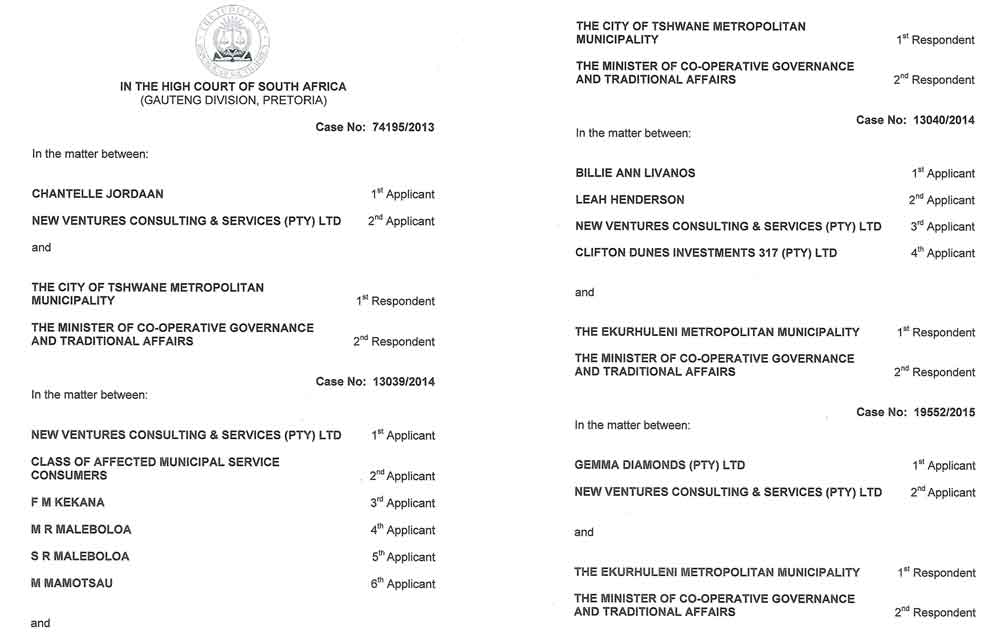
Instead, a series of individual High Court applications were launched over several years in the North Gauteng High Court, each with its own case number, facts, and affected parties.
These matters included, among others, applications in which New Ventures Consulting & Services (now Municipal Debt Specialist) appeared as an applicant:
- Case No: 74195/2013 – Chantelle Jordaan & New Ventures Consulting & Services
- Case No: 13039/2014 – FM Kekana, MR Maleboloa, SR Maleboloa, M Mamotsau & New Ventures
- Case No: 13040/2014 – Billie Ann Livanos, Leah Henderson, Clifton Dunes Investments & New Ventures
- Case No: 19552/2015 – Gemma Diamonds (Pty) Ltd & New Ventures
- Case No: 23826/2014 – Oak Plant Rentals (Pty) Ltd, Stepping the World (Pty) Ltd & New Ventures
Each matter arose from similar underlying issues, but was pursued independently by New Ventures on behalf of the respective applicants.
Across these cases, a consistent legal question began to emerge:
- Whether municipalities could recover historical debts from new property owners; and
- Whether municipalities could refuse to provide services despite compliance with the legal requirements of transfer.
Repeated High Court Outcomes (2013–2016)
Over time, these matters progressed through the High Court individually.
In each instance, the High Court found in favour of New Ventures’ clients, with orders granted that addressed the unlawfulness of the municipalities’ conduct and clarified the obligations owed to new property owners.
These outcomes reflected a growing judicial recognition that the interpretation being applied by certain municipalities was inconsistent with constitutional principles and statutory intent.
By late 2016, several of these matters had resulted in successful outcomes for our firm and its clients.
This marked a major step toward restoring legal clarity.
Given the constitutional issues raised, aspects of the matters proceeded to the Constitutional Court for final determination.

From Individual Cases to a Constitutional Court Challenge
Despite these High Court outcomes, the municipalities persisted in advancing their interpretation and exercised their right to appeal.
The Constitutional Court proceedings therefore did not represent the beginning of the dispute, but rather:
The culmination of several years of litigation arising from our firm’s municipal debt consulting practice, across multiple individual matters.
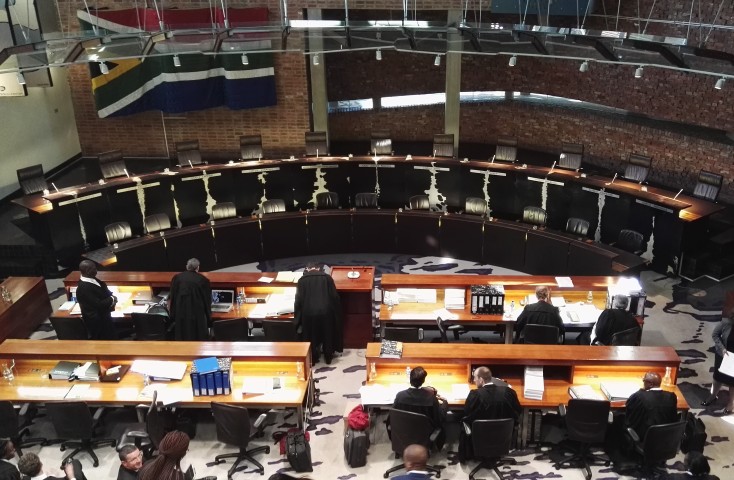
New Ventures Consulting & Services / Municipal Debt Specialist fighting for the nation
The Constitutional Court Judgment (2017)
The Constitutional Court heard the combined matters in May 2017, addressing the broader legal principles arising from the disputes.
By this stage, the matter had already:
- Evolved through multiple High Court applications
- Involved numerous affected property owners
- Raised issues of national importance
The significance of the case attracted participation from various stakeholders, including amici curiae (friends of the court), reflecting the broader impact of the issues under consideration.
On 29 August 2017, the Constitutional Court delivered its judgment.
The ruling clarified key aspects of Section 118 and provided much-needed certainty regarding municipal debt and property ownership in South Africa.

section 118 judgment
Timeline of our Jordaan Litigation and Section 118 Disputes
The development of the Jordaan matter can best be understood through the following timeline:
| Year / Period | Key Event |
|---|---|
| 2002 | Early litigation and engagement regarding Section 118 initiated by New Ventures Consulting & Services (Livanos). |
| 2002–2013 | Thousands of municipal debt matters handled, including the assessment and reduction of inflated clearance figures by Municipal Debt Specialist (formerly New Ventures Consulting & Services). |
| 2013 | New disputes emerge following changing interpretations of Section 118 and related case law. |
| 2013–2015 | Multiple High Court applications launched by New Ventures Consulting & Services on behalf of affected property owners. |
| November 2016 | High Court rulings address the lawfulness of municipal conduct across multiple matters. |
| May 2017 | Constitutional Court hearing. |
| 29 August 2017 | Landmark Constitutional Court judgment delivered. |
| Post-2017 | The judgment continues to have widespread impact across the property sector in South Africa. |
National Attention and Industry Impact

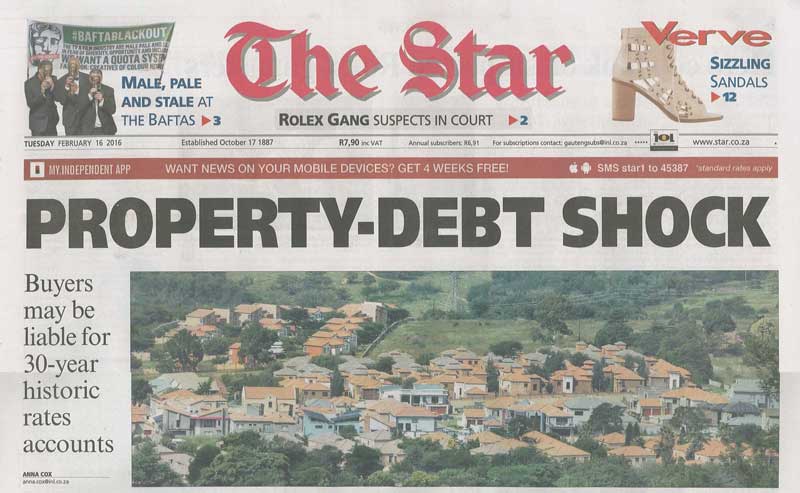
Following the Constitutional Court judgment, the matter received widespread attention across:
- Television and radio platforms
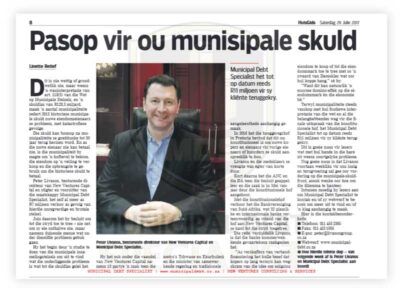
- National and regional newspapers
- Property and legal publications
This coverage reflected the significance of the judgment and its implications for:
- Property owners
- Conveyancing attorneys
- Financial institutions
- Municipalities
How the Judgment Continues to Protect Property Owners Today
The Jordaan judgment remains a key reference point in South African property law.
It continues to:
- Provide clarity on municipal debt obligations
- Protect purchasers from historical liabilities
- Support fair and predictable property transactions
- Guide conveyancers, banks, and municipalities
What This Means for Buyers, Sellers, Banks and Conveyancers
The legal certainty created by the judgment has had lasting benefits:
- Buyers can proceed with greater confidence
- Sellers have clearer obligations
- Conveyancers can rely on established legal principles
- Banks benefit from reduced transactional risk
- Municipalities operate within clearer legal boundaries
The Legacy of the Jordaan Judgment
The Jordaan Constitutional Court matter did not arise from a single dispute.
It was the culmination of:
- Years of practical experience developed through MDS’s municipal debt practice
- Thousands of real-world municipal debt matters audits and reductions on high clearance figures
- Multiple legal challenges involving ordinary property owners
What began as a consulting practice focused on helping clients navigate municipal debt and high clearance figures, ultimately evolved into one of the most significant property law developments in South Africa.
The outcome continues to shape how municipal debt is understood, applied, and enforced today.
Frequently Asked Questions About The Jordaan Judgment
Who Was Chantelle Jordaan?
Chantelle Jordaan was one of several affected property owners whose matter ultimately formed part of the litigation that reached the Constitutional Court.
Her name became associated with the landmark judgment because court cases are typically cited using the names of the litigants involved.
The broader litigation involved multiple affected property owners and related matters that collectively contributed to the development of South African Municipal debt law.
What Role Did Municipal Debt Specialist Play In The Jordaan Litigation?
Municipal Debt Specialist, formerly known as New Ventures Consulting & Services, had been assisting property owners with Municipal debt, Clearance Figures and Section 118 disputes for many years before the Constitutional Court proceedings.
The matters that ultimately formed part of the litigation arose from real client disputes encountered in our firm’s practice encountered during regular clearance figure reduction matters.
Over time, multiple matters involving affected property owners progressed through the courts and ultimately contributed to the landmark Constitutional Court judgment.
What Did The Jordaan Judgment Decide?
The Constitutional Court considered important questions relating to Section 118 of the Municipal Systems Act and the treatment of historical Municipal debt following the transfer of property.
The judgment clarified key aspects of Municipal debt recovery and provided important legal certainty regarding the rights and obligations of Municipalities, property owners and purchasers.
The decision is now regarded as one of the most significant Constitutional Court judgments affecting Municipal debt and property transfers in South Africa.
Why Is The Jordaan Judgment Important?
The Jordaan judgment is important because it addressed issues that affected thousands of property owners, purchasers, conveyancers, financial institutions and Municipalities across South Africa.
The case helped clarify legal uncertainty surrounding historical Municipal debt and the extent to which Municipalities could seek to recover such debt following the transfer of ownership.
As a result, the judgment continues to influence property transfers and Municipal debt disputes throughout the country.
Does Historical Municipal Debt Transfer To A New Owner?
The Jordaan judgment provided important clarity regarding the treatment of historical Municipal debt after transfer.
While every matter depends on its own facts and legal circumstances, the Constitutional Court’s decision significantly influenced how historical Municipal debt is approached and interpreted in South African law.
Property owners, purchasers and conveyancers continue to rely on the principles established by the judgment when dealing with Municipal debt issues.
Can A Municipality Still Recover Historical Municipal Debt?
Yes.
The Jordaan judgment did not eliminate a Municipality’s right to recover lawfully owing debt.
Municipalities continue to have various legal mechanisms available to recover outstanding amounts from parties who remain legally liable for those debts.
The litigation focused on clarifying important legal principles regarding the recovery of historical Municipal debt and the consequences of property transfers.
How Does The Jordaan Judgment Affect Property Transfers Today?
The judgment continues to play an important role in property transfers throughout South Africa.
Conveyancers, attorneys, banks, property owners and other stakeholders regularly consider the legal principles established by the case when dealing with Municipal debt, Clearance Figures and property transfer risks.
The decision provides greater certainty regarding the legal treatment of historical Municipal debt following transfer.
Why Did The Litigation Receive National Attention?
The issues before the Constitutional Court had implications far beyond the individual litigants involved.
The outcome affected property owners, purchasers, conveyancers, financial institutions, estate agents and Municipalities throughout South Africa.
For this reason, the judgment attracted widespread interest from the legal profession, property industry, media organisations and various stakeholders concerned with Municipal debt and property transfer law.
Does The Jordaan Judgment Still Matter Today?
Absolutely.
The legal principles clarified by the Constitutional Court continue to be relevant whenever questions arise regarding historical Municipal debt, property transfers and Section 118 of the Municipal Systems Act.
The judgment remains one of the most frequently discussed Constitutional Court decisions in this specialised area of South African property law.
Further Information and Resources
Victory for Livanos – New Ventures Consulting & Services (MDS) in the Constitutional Court:
Landmark Ruling on Section 118 of the Municipal Systems Act
View the Landmark Judgment.
The Constitutional Court confirmed our stance by ruling that a Municipality’s security under Section 118(3) of the Local Government: Municipal Systems Act 32 of 2000 does not survive the transfer of property to a new owner. This decision is crucial for Property Buyers, as it means Municipalities must pursue outstanding debts from the previous owner before the property is transferred.
What Does This Mean for Property Owners?
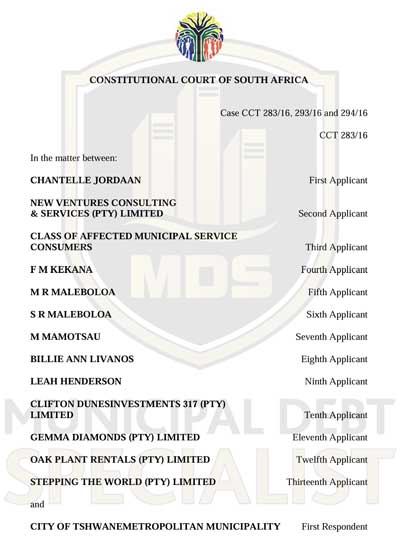
section 118 judgment
Municipalities retain their claim on the debt but lose the security of the property once it is transferred. The original owners remain liable for any outstanding debts, ensuring that new owners are not unfairly burdened.
This judgment resolves a long-standing legal controversy, affirming the rights of new property owners and highlighting the importance of professional Municipal Debt services, including the reduction of Municipal Clearance Figures, provided by MDS.
To read more about the judgment:
Public and Industry Response at the Time
During the course of the litigation, the issues attracted significant attention from professionals and stakeholders across the property industry.
Many individuals and organisations followed the progress of the matter closely and expressed their support, recognising the broader importance
of the issues being addressed.
The following are examples of comments received during that period:
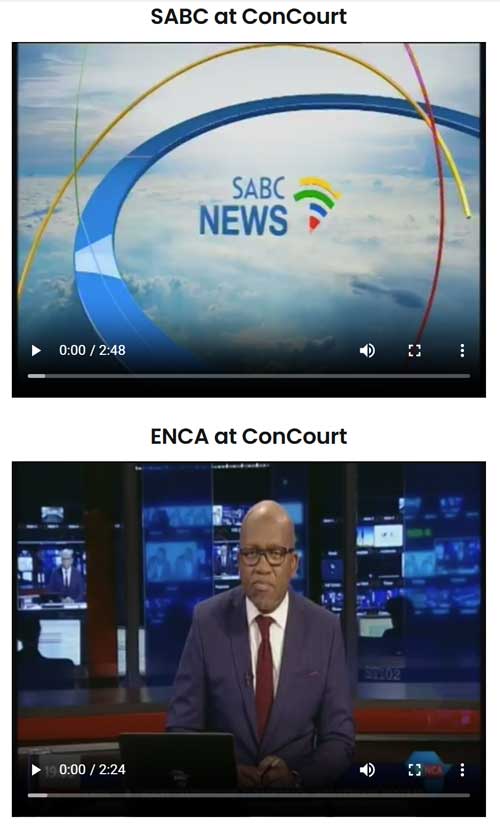
SABC News:
Municipal Debt Specialist Declared Victorious
view all media
View all Radio | Television | Newspapers | Media Coverage on the Municipal Debt Specialist
https://www.municipaldebt.co.za/section-118-experts-landmark-court-win-against-debt/
28 Aug
not my debt trending twitter number 1


LEGAL AND FAST MUNICIPAL CLEARANCE REDUCTIONS ON ALL TYPES OF SALES:
If you have purchased or sold a property and/or have any kind of high Clearance figures when transferring a Property, please contact the Municipal Debt Specialist to assist you.
We have a FREE RATES HELP DESK that you are most welcome to use.
We are able to assist with Municipal Clearance Figures on all kinds of Property Transfers, i.e. Deceased Estates, Liquidations/Sequestrations, Normal Sales, etc.
Discover More About Our Expertise and Success:
- Read a bit more About Us.
- For more information about our services or to discuss your needs, please Contact Us.
- Our team is ready to offer expert support and ensure a smooth, efficient property transfer process.
- Please also consider our NO OBLIGATION & FREE Rates Clearance Help Desk offering.
- Why not read what other clients have to say about us under our Client Testimonials.
- Do you know what a Clearance Figure or Certificate even looks like or is? Please visit our Frequently Asked Questions page.
- Last but not least please check out our amazing News & Updates in the National Media on our massive wins, acclaims and interesting articles and blogs.

Advanced Living Solutions

Audioholics
Estate Agent
Finance House
Attorney
Ratepayer
Commercial Broker
Attorney
Property Owner
Attorney
Bank
Agent