
High Rates Clearance Figures – How Fear Is Being Exploited
The Hidden Risk in Property Transfers That Most People Don’t Understand
High rates clearance figures push desperate sellers into fear-driven shortcuts. These shortcuts often carry devastating Section 118 consequences. They are either lured into thinking they are getting a discount when they are not; because not everyone truly understands Section 118, or they trust the wrong people.
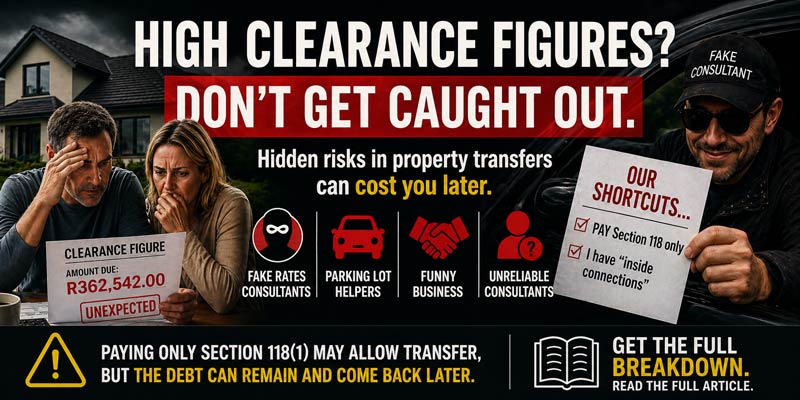
Beware of “shortcuts”
– Please click on each heading below to read more –

Many property sellers are shocked when their High Clearance Figures are far higher than expected at transfer stage.
This is not unusual — it is often the result of how municipalities account for historical debt and recovery processes.
Under pressure, sellers are frequently advised to:
- Take shortcuts or quick solutions
- — including paying only the minimum required for clearance or relying on unofficial “assistance”.
While this may appear to solve the problem, it can create serious legal and financial consequences later, including ongoing liability after transfer.
Understanding the difference between transferring a property and fully resolving municipal debt is critical.
NOTE:
- If you have reached this point, you may already be dealing with high clearance figures — or trying to understand why they occur.
- What follows below is a deeper explanation of:
–What is really happening,
–Where the risks lie, and
–Why so many property transactions go wrong at this stage.
Recent media investigations into municipal billing irregularities in Ekurhuleni have highlighted serious concerns about how municipal accounts can appear settled or significantly reduced due to system vulnerabilities or irregular interventions.
These reports indicate that, in certain cases, account balances reflected on municipal systems may not accurately represent the true legal position of the debt.
For property sellers, buyers, and financial institutions, this reinforces a critical principle:
a reduced or “cleared” balance on a system does not necessarily mean that the underlying legal obligation has been properly resolved.
This is precisely why fear‑driven shortcuts can create significant long‑term risk, particularly in the context of Section 118.
High Clearance Figures, Municipal Debt & the Questionable “Help” You Should NEVER Trust
If you are selling a property and have just discovered shockingly high rates clearance figures, you are not alone — and you are not stupid, careless, or dishonest.
In reality, this happens to ordinary South Africans every single day.

Unfortunately, when people panic, opportunists often target them — and the consequences can have serious financial and legal consequences.
Importantly, this article may save you from making critical mistakes.
If you ever plan to sell property — or know someone who might — this is something you cannot afford not to understand.
“I Only Owed R20,000… Suddenly They Want R100,000+”
This is one of the most common things we hear.
For years, property owners receive monthly municipal statements that appear manageable — maybe a few thousand rand behind, maybe a bit more.
Then:
- The property is sold
- The transferring attorney applies for municipal clearance figures
- And suddenly the amount explodes and catches everyone offguard
Importantly, this is not a scam. This is how municipal accounting actually works.

“Municipal internal ‘credits’ often reflect handover to collectors, not cancellation of liability.”
In simple terms:
What looks like a credit is often not a reduction — it is a shift in how the debt is recorded.
Debt Collection Procedures:
When unpaid debt is handed over to municipal debt collectors, the municipality often credits the owner’s account internally. This looks like a “credit” — but it is not a write-off, or a true credit!
However, the debt still exists.
It simply resurfaces at clearance stage. At that point, the full legally recoverable position must be disclosed in what is called Rates Clearance Figures. It is a summary of all the debts owing on the property plus extended figures and is part of the process in order to obtain a Rates Clearance Certificate.
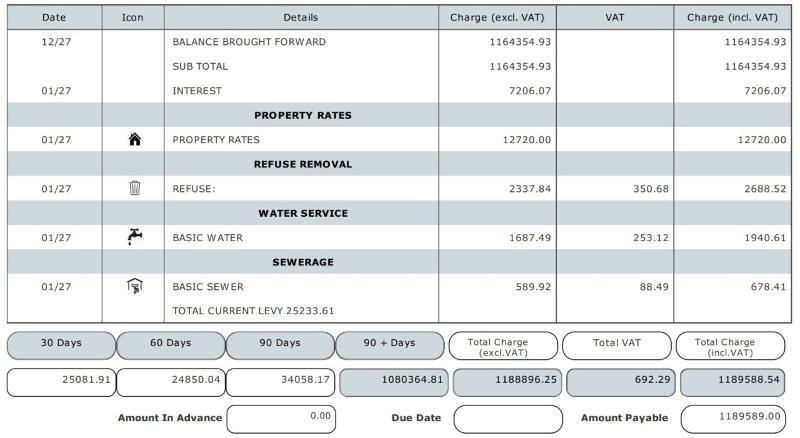
Statement DOES NOT always reflect True Debt
This specific moment involves high clearance figure debt, a signed sale, and a pending transfer. This is where exploitation thrives. Under the crushing weight of financial distress, rational legal analysis often gives way to “survival thinking.”
A seller in this position typically feels:
- Fear of the buyer walking away.
- Pressure from various parties to “just get it done.”
- Urgency to find any immediate fix.
The Fatal Next Move
Often, as a result, sellers are too embarrassed to declare their debt upfront for fear of being judged. They may not even know about the debt or realise it! When the true debt in the clearance figures finally surface, panic sets in.
They do what any desperate person would do: They go directly to the Municipality.
That is where the real danger begins. There is an unfortunate pattern emerging in South Africa: whenever a person is vulnerable, they are easily preyed upon. “Going it alone” innocently at the municipal office is the mistake that turns a financial crisis into a legal nightmare.
Across South Africa, we increasingly observe a brazen and disturbing pattern of exploitation:
- The Interception:
Individuals waiting in parking lots or various angles to approach property owners.
- The “Consultant“:
Unofficial fixers hanging around municipal buildings offering “inside connections” or purport to be some kind of “Rates Consultant” who has no track record, unproven and unverifiable as a legitimate profesional.
- The “Miracle“:
Promises of massive, immediate discounts for cash or informal payments.
- The “Fix”:
Claims that they can make debt vanish through secret, “inside” channels or “connections“.
……What makes this exploitation so effective is how ordinary it appears.
The environment looks official.
Meanwhile, the language sounds confident.
The promised relief feels immediate.
The Reality Check: Sometimes, improperly acting municipal officials are directly involved, giving the scam a thin veil of legitimacy.
However, for a brief moment, it may even look like it worked—until the municipality uncovers the wrong doings through their internal investigations… Everything is reversed, the transfer may be blocked, certificate revoked or the fraud uncovered.
If the solution sounds quick, secret, or “inside”—it is almost always unlawful.

What typically follows:
- Fraudulent or irregular “reductions”
- Clearance certificates later found to be invalid
- Municipal intervention or penalties
In more serious cases:
- Transfers delayed or blocked
- Legal claims after transfer
- Financial exposure for multiple parties

In practice, we have seen:
- Transfers/proceeds interdicted before lodgement at the Deeds office
- Sellers sued after transfer
- Sellers unpaid debts transferred to new innocent owners
- Judgments issued
- Assets attached
- People blacklisted
- In most cases, this occurs unknowingly, after professionals have relied on information later discovered to be irregular.
- Properties tied up for months or years
And tragically — it is always desperate, ordinary people who suffer, not the criminals who disappear.

Another widespread mistake is when someone tells you:
“My runner / rates consultant said:
Just pay the Section 118(1) amount.
That’s all you need to quickly get the deal through.”
For normal property sales, this is nonsense. While it may appear pragmatic in the short term, it shifts risk forward rather than eliminating it.

Section 118 Is NOT Discount
The Procedural Gatekeeper vs. The 30-Year Debt
Put simply:
Section 118(1) allows the property to transfer.
Section 118(3) is the debt that may still be enforced later.
It is vital to understand the difference between the two:
- Section 118(1):
-This is merely a “procedural gatekeeper” for the Deeds Office.
-It is the absolute minimum requirement to get a rates clearance certificate.
-It is issued only, so that a property can be transferred in the Deeds Office.
-IT DOES NOT MEAN ALL DEBTS ARE SETTLED OR FULLY PAID
- Section 118(3):
-This is the debt that was not paid for when getting a clearance certificate and is known as historical debt and does NOT disappear.
-Under South African law, the Municipality remains entitled to enforce this debt for up to 30 years where applicable.
-It has a very powerful right to this debt and even trumps a bank’s bond over the property.
Read More: Section 118 of the Municipal Systems Act explained in detail

The “Shatter” Effect
Importantly, the Municipality can act days, months, or even a decade after the transfer. We regularly see cases where individuals are caught off guard years later when a summons arrives usually when least expected.
Why Paying Only for a Clearance Certificate Cannot be Ignored
For property owners, banks, bridging finance providers and legal professionals, this creates unacceptable exposure:
- Municipalities can interdict transfers at the last minute.
- The municipality may freeze sale proceeds.
- Expected loan repayments fail, leaving the seller in a deeper hole than where they started.
The clearance certificate itself is not the risk—it’s the manner in which the historical debt was handled that determines if you are actually free of the property.

Importantly, this problem affects more than sellers. It places massive risk on Banks, Bondholders, Bridging finance companies and investors.
Short Term & Bridging finance loans often run for 14 days only.
If a transfer is interdicted or proceeds frozen due to unresolved municipal debt; loans cannot be repaid, capital is lost, entire transactions can collapse .
We have personally consulted on matters where bridging financiers were devastated financially because someone took a shortcut.

When people are tricked into only paying the bare minimum or the wrong person for the job is employed to assist, this does not only affect the seller and purchaser, it affects transferring attorney’s and real estate agents livelihood too.

In many cases, professionals rely on information that later proves to be incomplete or irregular.
Transferring attorney’s and real estate agents can only get paid their fees on successful registration.


Why Doing It “Properly” Is the Only Safe Option
There is only one lawful, safe approach:
✔️ Proper audit
✔️ Correct legal calculations
✔️ Lawful engagement with the Municipality
✔️ Settlement of the correct amounts only
✔️ No fraud
✔️ No shortcuts
Given the complexity and legal implications involved, this is not a process that should be approached informally or without proper expertise.
- We Audit & Reduce High Rates Clearance Figures the right way, legally & fast!
- We act on contingency.
- We charge nothing up front.
- We recover our fees out of savings created.
- There are no extra costs.
- No savings, No charge! Simple…

Livanos being interviewed winning at the Constitutional Court of SA – landmark ruling
Founded in 2002, Municipal Debt Specialist (formerly New Ventures Consulting & Services / Livanos) was established through Livanos and was the first to challenge Section 118 of the Municipal Systems Act—just two months after its introduction.
That early intervention laid the groundwork for what would become the definitive authority on Section 118. This position was ultimately confirmed by the Constitutional Court of South Africa.
Today, within municipal, financial and conveyancing circles, the name Livanos is widely recognised as synonymous with leading expertise in Section 118 of the Municipal Systems Act.

Constitutional Court day delivering Judgment – Municipal Debt Specialist – Livanos
Through Livanos, MDS specialises in the auditing and reduction of all debts prior to property transfer for:
Section 118(1),
Section 118(2), and
Section 118(3)
- We are not runners.
- We are not fixers.
- We do not bribe officials.
- We do not use shortcuts.
- Nor do not get “discounts“, we apply the Law
Shortcuts Are Easy. Defending Them Isn’t.
No Brown Envelopes. No Back Doors. Just the Law.
We are the firm that changed South African law & changed the lives of millions.

Our culmination of dedication and hard work after many years resulted in the landmark Constitutional Court case: Jordaan v City of Tshwane, run and won by Livanos, reshaped how Section 118 is interpreted across the country.
This judgment did not benefit clients alone — it reshaped how municipalities, banks, and conveyancers manage risk nationwide.
NO ONE CAN CLAIM OUR CREDIBILITY

That is why:
- Municipalities know the name Livanos
- Banks trust our methods
- Attorneys, real estate agents, Rate Payers rely on us in to reduce High Clearance Figures fast and legally
- Financial institutions treat our involvement seriously
Our methodologies are court approved, lawful, and defensible.
MDS is the gold stamp of Approval. This process is designed to fit seamlessly into legitimate conveyancing workflows — not disrupt them.

Most importantly:
We prevent people from ruining their lives by trusting the wrong help.

Stop. Don’t Walk into a Trap.
If you are:
- Shocked by high clearance figures
- Cash strapped
- Desperate
- Confused
- Being promised miracles
DO NOT:
-Go at it alone
-Trust parking lot helpers
-Take Section 118 shortcuts
High municipal debt creates fear.
Fear creates shortcuts.
Shortcuts expose everyone involved.

📞 Contact Municipal Debt Specialist (MDS)
📍 A Livanos Group of Companies
📧 rateshelp@livanosgroup.co.za | 📱 +27 (010) 443 4443 | WhatsApp +27 81 622 3375
We have rescued thousands of people — legally, ethically, fast and safely.


Advanced Living Solutions

Audioholics