
Offer to Purchase Risks OTP: Municipal Debt & Clearance Trap
– Please click on each heading below to read more –
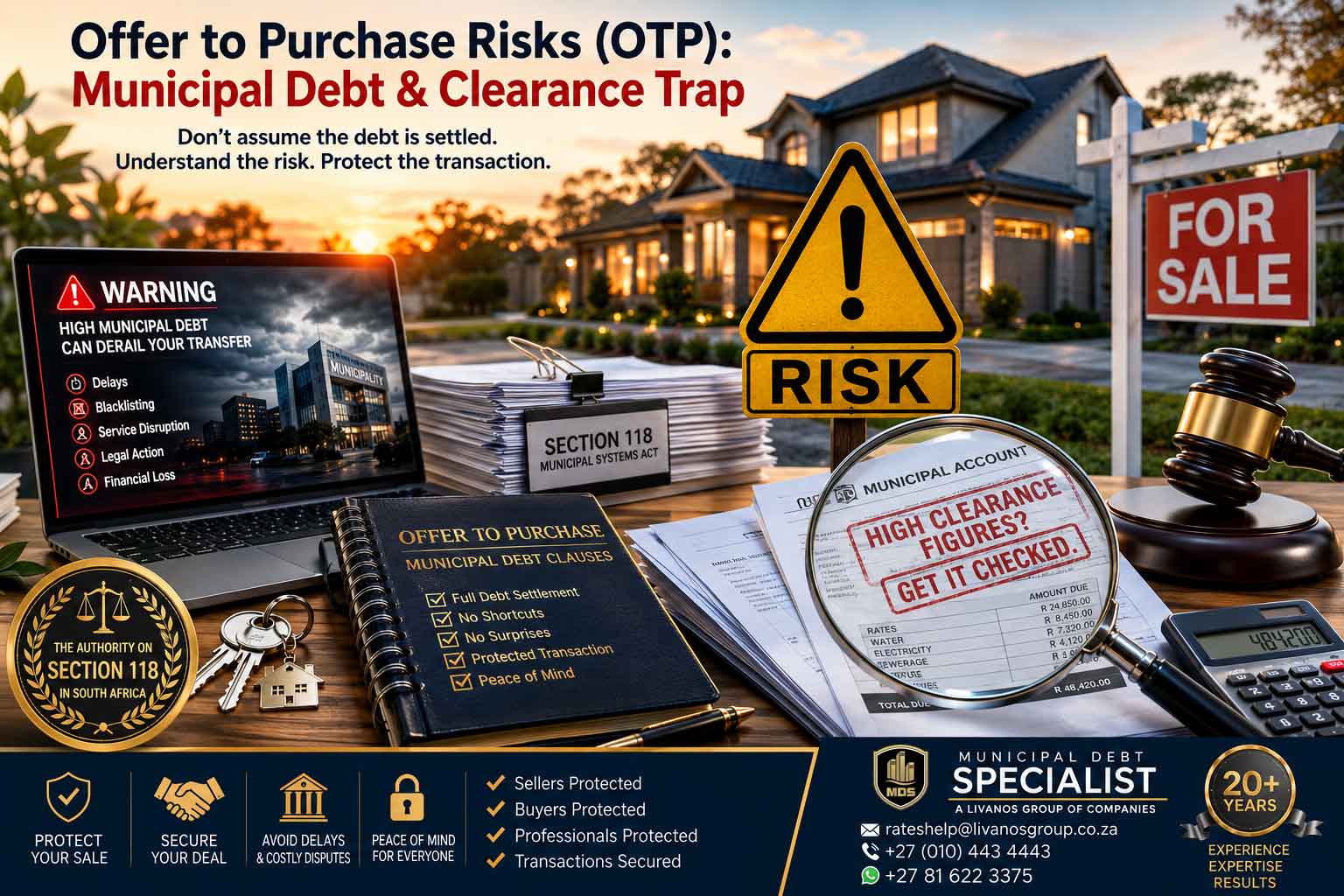
There’s a risk hiding in almost every Offer to Purchase — and most property professionals overlook it.
It revolves around municipal clearance and Section 118.
In practice:
- Estate agents wait for commission that may be delayed
- Conveyancers are pressured to register with incomplete figures
- Buyers assume everything has been settled
- Banks and lenders fund transactions on incorrect assumptions
Most people believe:
“The seller must just pay what’s due.”
But this is not how transactions actually play out.
When things go wrong, the consequences affect everyone involved — often after it’s too late to fix the structure of the deal.
If you are involved in property transfers in any way, this is a risk you need to understand.
Prefer a quicker overview?
Download our 3-Minute Guide to understand:
- Where the real risk starts in an OTP
- Why clearance figures are often misunderstood
- How this affects agents, conveyancers, buyers and lenders
or continue below for a full detailed breakdown.
Why Your Offer to Purchase Is Putting You at Risk:
The Municipal Debt and Clearance Certificate Trap

The Problem Few Estate Agents are Addressing Properly in the Offer to Purchase:
Across South Africa, thousands of property transactions are still being structured on vague, outdated, and dangerously incomplete Offer to Purchase (OTP) clauses when it comes to municipal debt.
Most OTPs simply require the seller to:
“obtain a Rates and Taxes Clearance Certificate.”
or may even be silent….

On the surface, this sounds correct, because prior to 2001 no properties could transfer unless all debts owing to a municipality were settled in full.
In reality, it is one of the most misunderstood and high-risk provisions in property law today.
Because a clearance certificate in terms of Section 118(1):
- Only confirms payment of the last two years’ municipal charges, and
- Does NOT confirm that all municipal debt has been settled
Yet many professionals — including estate agents, sellers, and even conveyancing staff — still act as if it does.
This misunderstanding is not just technical.
It is costly, dangerous, and increasingly being exploited — with unsuspecting sellers often misled into decisions that expose them to significant financial and legal risk (read more about how sellers are being exploited here).
We have explained previously, Section 118 is not a discount mechanism…. Click here to read this article
Legally, according to our landmark Constitutional Court judgment which has changed the law in South Africa and become extremely famous has confirmed that:
- Historic municipal debt may not be transferred to a new owner
However, in practice:
- Some municipalities still refuse services
- Some delay or obstruct consumer agreements
- Some use aggressive collection tactics
- Purchasers are often forced to pay historic debt or face litigation

This creates a harsh reality:
What is legally correct is not always what happens in practice.
The only way for a purchaser to enforce their rights is often:
- A High Court application
- Significant legal costs
- Prolonged delays
- Financial and emotional strain
- Pay the previous owner’s debt
Most purchasers cannot afford this.
So they capitulate.
The risk does not begin at the municipality. 
It begins at the Offer to Purchase stage. This is where the risk begins
When OTP clauses are vague, they:
- Allow sellers to do the bare minimum
- Encourage conveyancers to request minimum compliance figures
- Create pressure to “just get the deal through”
- Open the door to shortcuts, misrepresentation, and abuse
Please read: How Fear Is Being Exploited
This is where every stakeholder becomes exposed:
- Seller
- Purchaser
- Estate agent
- Transferring attorney
- Bridging finance providers
- The banks
If the industry is serious about preventing downstream disputes, then the solution must begin at the contracting stage. The time has come for property professionals to move away from outdated practices and take a proactive role in preventing disputes.
This is not theoretical — this is the reality on the ground, and we see it every day.
Below is a suggested framework that estate agents and conveyancers can adopt to better protect all parties involved:
Suggested Municipal Debt Clauses for Offers to Purchase
Full Municipal Debt Settlement Obligation
The Seller warrants and undertakes to settle all municipal charges, debts, and arrears of whatsoever nature relating to the Property, including but not limited to rates, taxes, electricity, water, refuse, sewerage, penalties, and interest, up to the date of transfer.
Distinction from Clearance Certificate Requirements
The Parties acknowledge that a Rates Clearance Certificate issued in terms of Section 118(1) of the Local Government: Municipal Systems Act, 32 of 2000, reflects limited statutory compliance only (typically the preceding two years) and does not constitute confirmation that all municipal debts have been extinguished.
No Reliance on Minimum Compliance Figures
Indemnity in Favour of the Purchaser
The Seller indemnifies and holds the Purchaser harmless against any claims, liabilities, or service disruptions arising from municipal debt incurred during the Seller’s period of ownership, and undertakes to take all reasonable steps to resolve any historic municipal issues — including those arising under Section 118(3) of the Municipal Systems Act — identified prior to transfer.
Lawful and Professional Conduct in Dispute Resolution
The Parties agree that where any municipal charges are disputed or challenged, such processes shall be undertaken strictly through lawful, transparent, and professionally recognised channels. The Seller undertakes not to engage in, entertain, or rely upon any informal, unverified, or potentially unlawful practices — including but not limited to “back-door” arrangements, unsolicited intermediaries, or individuals presenting themselves as “rates consultants” without appropriate expertise or accreditation. The Seller further undertakes that no actions will be taken which may be considered irregular, suspicious, or fraudulent, or which may jeopardise the validity, timing, or success of the transfer process.
These clauses are not exhaustive but are intended to highlight the level of clarity and protection that is increasingly required in today’s property environment.
A growing trend has emerged: 
- Sellers only pay what is required for a clearance certificate because that is what the OTP says
- Some conveyancing secretaries request two-year figures only
- Shortcuts are taken in an attempt to speed up transactions
- Legitimate current-owner debt is wrongly ignored due to Section 118 misunderstandings
This environment has enabled:
- Unqualified “rates consultants”
- So-called “runners” and “fixers”
- Misleading advice about Section 118
- Corrupt or irregular practices in some instances
One of the most dangerous myths being sold:
That Section 118 is a “discount mechanism” or a way to reduce debt
This is completely incorrect. Section 118 is not a discount in any way!
Section 118:
- Is a security provision
- Protects municipal revenue
- Does not extinguish debt older than two years
- Does not offer discounts in any form way or manner
Failure to understand this has led to:
- Sellers believing debt has disappeared or been written off
- Purchasers inheriting risk
- Professionals exposing themselves to liability
Sellers
- Municipalities may pursue rates & taxes for up to 30 years under the Prescription Act
- Risk judgment, blacklisting, and enforcement
- Lose access to sale proceeds if transactions are delayed or interdicted
Purchasers
- Wrongfully be denied water, electricity, services or be allowed to open a new consumers agreement
- Forced to pay previous owner’s debt
- Risk expensive High Court litigation
Estate Agents
- Commission at risk if transfer is delayed or blocked
- Reputational damage
- Potential exposure to negligent misrepresentation
Conveyancing Attorneys
- Risk of professional liability
- Exposure where advice or instructions lead to insufficient compliance
- Reliance on incorrect or incomplete clearance assumptions
The Transaction Itself – When things go wrong: 
- Transfers are delayed, stopped or proceeds frozen
- Bridging finance is disrupted
- Entire property chains collapse
This is the reality on the ground despite what the law says
Despite years of litigation and clarity around Section 118, many professionals still misinterpret the law

- Some stakeholders are incentivised to prioritise speed over compliance
- Misleading information continues to circulate
- Municipal enforcement practices remain inconsistent
Most importantly:
Many real estate agencies’ Offers to Purchase have not evolved to reflect the true risk environment.
The most effective way to protect all parties is simple:
Make it a contractual obligation that the seller must settle ALL municipal debt — not just the last two years — before transfer.
This requires OTP clauses to clearly distinguish between:
- Clearance certificate requirements
- Full debt settlement obligations
- Prevent reliance on minimum compliance shortcuts
- Mandate independent verification by appropriately qualified and accredited professionals where necessary
OFFER TO PURCHASE & MUNICIPAL DEBT:
Before 2001, the law effectively required:
- Full settlement of municipal debt before transfer
The current framework changed that — but not the underlying reality:
Municipalities are still obligated to collect their debt.
This means:
- Debt does not disappear
- It does not prescribe quickly
- It remains enforceable
Professionals must therefore act responsibly:
- Not just legally
- But practically and ethically
The industry must move away from: 
- Minimal compliance
- Assumptions about clearance certificates
- Reliance on unqualified intermediaries
And towards:
- Accurate debt assessment
- Transparent OTP clauses
- Full-risk disclosure
- Collaboration with qualified specialists

No Shortcuts. No Surprises. No Unintended Consequences.
- Reduce inflated or incorrect municipal debt
- Identify billing errors
- Structure lawful solutions
But these must be:
- Legal
- Transparent
- Sustainable
Not based on:
- Myths
- Misinterpretations
- Or dangerous shortcuts
This is where most transactions go wrong:
- Estate agents are not trained in municipal law
- Conveyancers are not appointed to audit municipal accounts
- Municipalities do not proactively correct errors or reduce inflated figures
- Buyers and sellers rely on assumptions — not verified data
- Bridging finance service providers and banks suffer financial consequences
As a result, the system unintentionally allows incorrect, high, or incomplete clearance figures to pass through the transaction.
This is not negligence — it is a structural gap in the process.
And unless an accredited specialist intervenes, the risk remains hidden until it becomes a problem.
A vague Offer to Purchase is no longer just a minor oversight — it is a systemic risk.

If the industry does not correct this at the contracting stage:
- Sellers will remain exposed
- Purchasers will continue to suffer
- Professionals will face increasing legal and financial consequences
If you are involved in any property transaction where municipal debt exists:
- Do not assume the figures are correct.
- Do not assume the risk has been addressed.
Have the clearance figures professionally reviewed before transfer.
We offer a no-obligation assessment of municipal clearance figures to identify:
- Inflated or incorrect charges
- Legal reduction opportunities
- Hidden risks that could affect the transaction
Submit your figures here: Rates Help Desk
This is the Essence Municipal Debt Specialist:
- We Audit & Reduce High Rates Clearance Figures the right way, legally & fast!
- We act on contingency.
- We charge nothing up front.
- We recover our fees out of savings created.
- There are no extra costs.
- No savings, No charge! Simple…

Livanos being interviewed winning at the Constitutional Court of SA – landmark ruling
Founded in 2002, Municipal Debt Specialist (formerly New Ventures Consulting & Services / Livanos) was established through Livanos and was the first to challenge Section 118 of the Municipal Systems Act—just two months after its introduction.
That early intervention laid the groundwork for what would become the definitive authority on Section 118. This position was ultimately confirmed by the Constitutional Court of South Africa.
Today, within municipal, financial and conveyancing circles, the name Livanos is widely recognised as synonymous with leading expertise in Section 118 of the Municipal Systems Act.

Constitutional Court day delivering Judgment – Municipal Debt Specialist – Livanos
Through Livanos, MDS specialises in the auditing and reduction of all debts prior to property transfer for:
Section 118(1),
Section 118(2), and
Section 118(3)
- We are not runners.
- We are not fixers.
- We do not bribe officials.
- We do not use shortcuts.
- Nor do not get “discounts“, we apply the Law
Shortcuts Are Easy. Defending Them Isn’t.
No Brown Envelopes. No Back Doors. Just the Law.
We are the firm that changed South African law & changed the lives of millions.

Our culmination of dedication and hard work after many years resulted in the landmark Constitutional Court case: Jordaan v City of Tshwane, run and won by Livanos, reshaped how Section 118 is interpreted across the country.
This judgment did not benefit clients alone — it reshaped how municipalities, banks, and conveyancers manage risk nationwide.
NO ONE CAN CLAIM OUR CREDIBILITY

That is why:
- Municipalities know the name Livanos
- Banks trust our methods
- Attorneys, real estate agents, Rate Payers rely on us in to reduce High Clearance Figures fast and legally
- Financial institutions treat our involvement seriously
Our methodologies are court approved, lawful, and defensible.
MDS is the gold stamp of Approval. This process is designed to fit seamlessly into legitimate conveyancing workflows — not disrupt them.

Most importantly:
We prevent people from ruining their lives by trusting the wrong help.

Stop. Don’t Walk into a Trap.
If you are:
- Shocked by high clearance figures
- Cash strapped
- Desperate
- Confused
- Being promised miracles
DO NOT:
-Go at it alone
-Trust parking lot helpers
-Take Section 118 shortcuts
High municipal debt creates fear.
Fear creates shortcuts.
Shortcuts expose everyone involved.
The MDS Position:
No shortcuts
No minimum compliance
No reliance on myths
Only the law

📞 Contact Municipal Debt Specialist (MDS)
📍 A Livanos Group of Companies
📧 rateshelp@livanosgroup.co.za | 📱 +27 (010) 443 4443 | WhatsApp +27 81 622 3375
We have rescued thousands of people — legally, ethically, fast and safely.


Advanced Living Solutions

Audioholics